
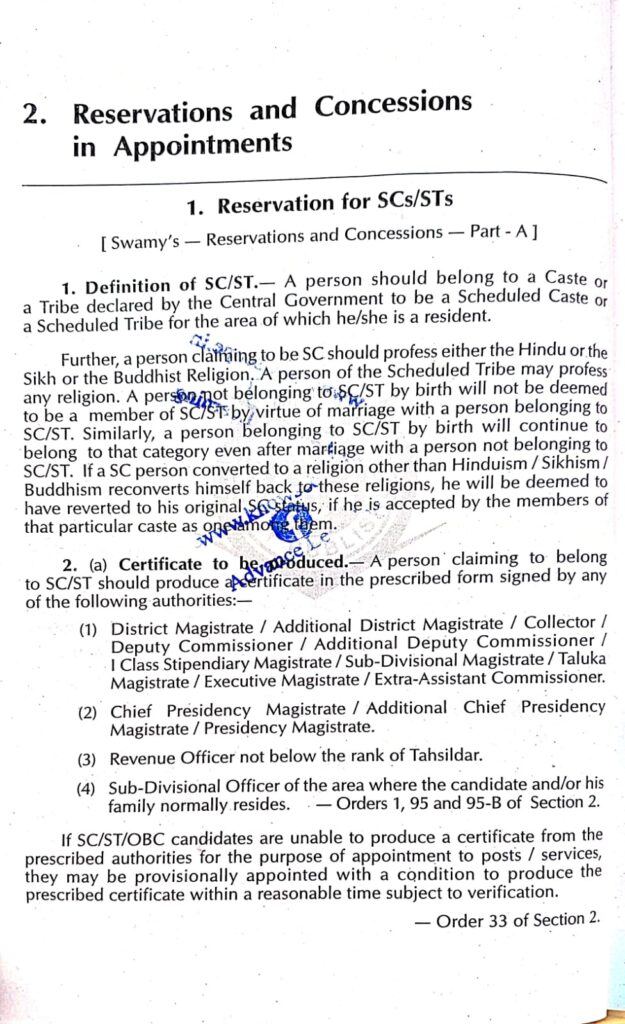
Reservations and Concessions in Appointments as per Swamy’s Handbook 2026
Introduction to Reservation Policy in Government Appointments
Reservation in government appointments is one of the most significant tools used to ensure equal opportunity in public employment. It exists to correct historical inequalities and provide fair representation to socially and economically disadvantaged groups. If you have ever applied for a government job, you have probably noticed various relaxations — age, fees, or qualifying marks. These are not random benefits; they are structured policies explained clearly in Swamy’s Handbook 2026.
The purpose of reservation is simple yet powerful: inclusion. By creating opportunities for under-represented communities, the government promotes diversity, fairness, and social justice within public services.
Overview of Swamy’s Handbook 2026
Swamy’s Handbook is widely regarded as a practical reference guide for government rules related to service matters. The 2026 edition continues this tradition by providing updated guidelines on reservations, concessions, recruitment rules, and compliance procedures.
For government employees, administrators, and job aspirants, this handbook acts like a roadmap. It explains not only what the rules are but also how to implement them correctly.
Categories Covered Under Reservation
Reservation policies apply to several constitutionally recognised categories. Scheduled Castes (SC) and Scheduled Tribes (ST) receive reservation to address long-standing social disadvantages. Other Backward Classes (OBC) are included to ensure representation of socially and educationally backward communities.
Economically Weaker Sections (EWS) represent a more recent addition, focusing on financial disadvantage irrespective of caste. Persons with Benchmark Disabilities (PwBD) fall under horizontal reservation, ensuring inclusive employment across categories.
Together, these groups form the core structure of reservation in appointments.
Reservation Percentages in Direct Recruitment
In central government recruitment, reservation percentages are defined clearly. Typically, SC receive 15%, ST 7.5%, OBC 27%, and EWS 10%, while PwBD reservation is applied horizontally across categories.
Departments must follow roster-based allocation rather than ad-hoc vacancy distribution. This ensures fairness over time instead of random selection.
Reservation in Promotions
Reservation does not stop at entry-level recruitment. In many cases, it extends to promotions, subject to legal guidelines and court rulings. Swamy’s Handbook explains the post-based roster system used for promotions, ensuring representation continues across career progression.
Promotion reservation is often debated, but its objective remains consistent — representation at higher levels.
Concessions Provided to Reserved Categories
Concessions play a crucial role alongside reservation. Age relaxation is one of the most common benefits, allowing candidates additional years to apply. Fee exemption reduces financial barriers during application.
Qualification or experience relaxation may also be provided where appropriate, especially when strict criteria could limit representation. These concessions help level the playing field rather than give unfair advantage.
POLICY OF RESERVATION TO SC ST AND OBC
Click here to download the full notification in PDF
Click here to download the Swamy’s Handbook in PDF
Relaxation for Persons with Disabilities
Persons with disabilities receive additional support measures beyond reservation percentage. Special recruitment drives are organised to fill backlog vacancies. Functional classification of posts ensures candidates are matched to suitable roles.
This approach shifts focus from limitation to capability — a major policy evolution.
Reservation in Examinations and Selection Process
Selection procedures often include relaxed standards for reserved categories. Separate cut-offs, extended attempt limits, and accessible exam arrangements are examples.
The idea is not to compromise merit but to account for unequal starting conditions. Think of it like adjusting the starting line in a race so everyone has a fair chance to compete.
Roster System Explained
The roster system is the backbone of reservation implementation. Instead of reserving individual vacancies randomly, posts are mapped across a roster cycle such as the 100-point roster.
The shift from vacancy-based to post-based roster was a major reform. It prevents excessive or insufficient reservation and ensures long-term balance.
Carry Forward Rule
Sometimes reserved vacancies remain unfilled. The carry forward rule allows these vacancies to move to the next recruitment cycle as backlog vacancies. This prevents loss of representation.
However, de-reservation is permitted only under strict conditions and with approval, ensuring the policy’s intent is preserved.
Horizontal vs Vertical Reservation
Vertical reservation refers to SC, ST, OBC, and EWS categories. Horizontal reservation cuts across them, covering groups such as women, persons with disabilities, and ex-servicemen.
Understanding this distinction is essential because horizontal reservation is adjusted within each vertical category rather than added separately.
Role of Liaison Officers
Implementation requires monitoring. Liaison Officers are appointed in departments to oversee reservation compliance, maintain rosters, and submit reports.
They act as watchdogs of the policy, ensuring rules are followed consistently.
Documentation and Verification
Reservation benefits depend heavily on proper documentation. Valid caste certificates, disability certificates, and income certificates must be verified before appointment.
Swamy’s Handbook highlights the importance of scrutiny to prevent misuse while protecting genuine candidates.
Challenges in Implementation
Despite clear rules, implementation challenges exist. Administrative delays, lack of awareness, and documentation issues can affect candidates. Departments may also struggle with maintaining accurate rosters.
Digitalisation is gradually addressing these issues, but awareness remains crucial.
Importance for Candidates and Departments
For candidates, understanding reservation rules can significantly influence eligibility and preparation strategy. For departments, proper implementation ensures transparency, legal compliance, and trust.
Reservation is not just a policy — it is a governance responsibility.
Future Trends in Reservation Policy
The future points toward digital roster management, automated verification, and data-driven monitoring. Policy refinements may continue as social realities evolve.
Swamy’s Handbook 2026 reflects this shift by emphasising clarity, compliance, and technology integration.
Conclusion
Reservations and concessions in appointments remain central to inclusive public employment in India. Swamy’s Handbook 2026 provides a comprehensive framework that explains who is eligible, what benefits apply, and how departments must implement them.
When understood correctly, reservation is not about advantage — it is about access. It ensures that talent from every background gets an opportunity to participate in nation-building. For candidates, administrators, and policymakers alike, mastering these guidelines is essential for fair and transparent recruitment.
FAQs
1. What is the main purpose of reservation in government appointments?
The main purpose is to ensure fair representation and equal opportunity for socially and economically disadvantaged groups.
2. Does reservation apply to promotions as well?
Yes, in many cases reservation applies to promotions through post-based roster systems, subject to legal guidelines.
3. What concessions are commonly provided?
Age relaxation, fee exemption, relaxed qualifying marks, and experience relaxation are common concessions.
4. What is the difference between horizontal and vertical reservation?
Vertical reservation applies to categories like SC, ST, OBC, and EWS, while horizontal reservation covers groups like PwBD, women, and ex-servicemen across categories.
5. What happens to unfilled reserved vacancies?
They are carried forward as backlog vacancies to future recruitment cycles unless de-reservation is approved.
POLICY OF RESERVATION TO SC ST AND OBC
Click here to download the full notification in PDF
Click here to download the Swamy’s Handbook in PDF
Disclaimer
The information provided in this article on “Reservations and Concessions in Appointments as per Swamy’s Handbook 2026” is intended for general informational and educational purposes only. While every effort has been made to ensure accuracy and reliability, the content should not be treated as an official statement of government policy, legal advice, or a substitute for referring to original rules, notifications, circulars, or the latest edition of Swamy’s Handbook.
Reservation policies, eligibility criteria, percentages, and concessions are subject to change based on government orders, court decisions, and departmental instructions issued from time to time. Readers are strongly advised to verify details from official government sources, recruitment notifications, or competent authorities before making any decisions related to applications, appointments, promotions, or service matters.
The author and publisher shall not be held responsible for any errors, omissions, interpretation differences, or outcomes arising from the use of this information. The responsibility for verifying authenticity and applicability of rules rests entirely with the reader.
This content is prepared for awareness and guidance purposes only and does not create any legal entitlement or claim for reservation, concession, or employment.
For more information and updates please follow the page and don’t forget to leave your comment.