
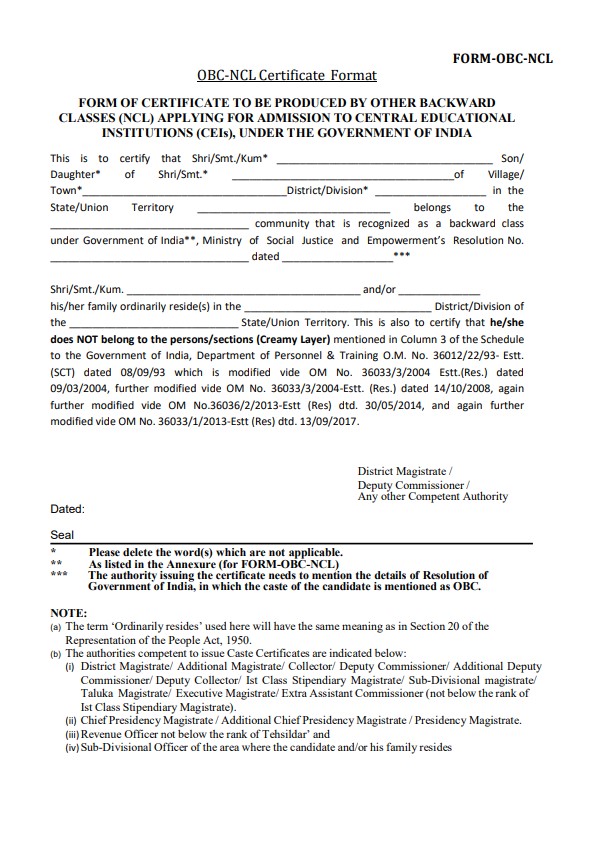
NCL Certificate and Rules
Introduction to NCL Certificate
If you’ve ever applied for a government job or admission under OBC quota, you’ve probably heard about the NCL certificate. But what exactly is it? And why does it matter so much?
Let’s break it down in simple terms.
What Does NCL Mean?
NCL stands for Non-Creamy Layer. It refers to a specific category within the Other Backward Classes (OBC) in India. The government divides OBC candidates into two groups: Creamy Layer and Non-Creamy Layer. Only those in the Non-Creamy Layer are eligible for reservation benefits.
Think of it like this: the reservation system is meant to uplift economically and socially weaker sections. If someone from OBC has already reached a financially stable or privileged position, they fall under the Creamy Layer and are excluded from certain benefits.
Why Is the NCL Certificate Important?
Without an NCL certificate, an OBC candidate cannot claim reservation benefits in central government jobs, educational institutions, or competitive exams. It acts as official proof that your family income and background meet the Non-Creamy Layer criteria.
In short, no certificate, no reservation benefit.
Understanding Non-Creamy Layer Concept
Background of OBC Reservation in India
The concept of OBC reservation was strengthened after the implementation of the Mandal Commission recommendations in the early 1990s. The aim was to create equal opportunities for socially and educationally backward classes.
However, over time, it became clear that some families within OBC had progressed economically. To ensure fair distribution of benefits, the Creamy Layer concept was introduced.
Creamy Layer vs Non-Creamy Layer
Here’s the difference in simple words:
Creamy Layer: OBC families with higher income or holding high-ranking positions.
Non-Creamy Layer: OBC families with income below the prescribed limit and not holding high constitutional or senior government posts.
Only Non-Creamy Layer candidates qualify for reservation under OBC in central government services.
Legal Framework Governing NCL Certificate
Role of the Government of India
The central government sets the rules and income limits for determining Non-Creamy Layer status. These rules apply mainly to central government jobs and institutions. States may have slightly different criteria for state-level benefits.
Income Criteria and Updates
Currently, the income limit for Non-Creamy Layer is generally ₹8 lakh per annum. This includes income from salary, business, profession, etc., but excludes certain types of agricultural income (subject to rules).
This limit may be revised from time to time by the government, so it’s important to check the latest notification before applying.
Eligibility Criteria for NCL Certificate
Eligibility depends on both income and occupation.
Income Limits
If the total annual income of parents is below the prescribed limit (usually ₹8 lakh), the candidate may qualify for Non-Creamy Layer status.
Remember, it’s the parents’ income that counts, not the candidate’s own income (unless they are independently earning and married).
Occupational Criteria
Income isn’t the only factor. The position held by parents also matters.
Government Employees
If either parent holds a high-ranking Group A or equivalent post in the government, the family may fall under the Creamy Layer, regardless of income.
Private Sector Employees
For private employees, income is the primary deciding factor. If it exceeds the limit consistently over a specified period, the family may be categorized under the Creamy Layer.
Agricultural Income Consideration
Agricultural income is treated differently. In many cases, pure agricultural income alone does not automatically place someone in the Creamy Layer. However, combined income from other sources may be considered.
Documents Required for NCL Certificate
To apply for an NCL certificate, you typically need:
OBC caste certificate
Income certificate of parents
Salary slips or IT returns
Identity proof (Aadhaar, PAN, etc.)
Address proof
Passport-size photographs
Proper documentation ensures smooth processing. Missing papers can delay or even reject your application.
Application Process for NCL Certificate
Applying is easier than you might think.
Online Application Procedure
Many states offer online portals where you can:
Register yourself.
Fill out the application form.
Upload required documents.
Submit the form.
Track the status online.
After verification, the certificate is issued digitally or can be downloaded.
Offline Application Procedure
If online facilities are unavailable, you can:
Visit the Tehsildar or Sub-Divisional Magistrate office.
Collect the application form.
Attach required documents.
Submit the application.
Wait for verification and approval.
The processing time usually ranges from 7 to 30 days.
Validity of NCL Certificate
An NCL certificate is generally valid for one financial year. This is because income criteria are reviewed annually. For most competitive exams, the certificate must be issued within a specific recent period mentioned in the notification.
So yes, you may need to renew it regularly.
Difference Between OBC Certificate and NCL Certificate
This is where many people get confused.
An OBC certificate confirms your caste category.
An NCL certificate confirms your economic eligibility within the OBC category.
You need both to claim OBC reservation benefits under central government rules.
Uses of NCL Certificate
Government Jobs
To avail reservation in central government jobs, an NCL certificate is mandatory.
Educational Institutions
Admissions in central universities, IITs, NITs, and other institutions under OBC quota require a valid NCL certificate.
Competitive Exams
Exams like UPSC, SSC, Banking, and Railways demand a recent NCL certificate for OBC candidates seeking reservation benefits.
Common Mistakes While Applying
People often:
Submit outdated income certificates
Use expired NCL certificates
Provide incorrect income details
Confuse state and central formats
Small mistakes can cost big opportunities. Always double-check the required format mentioned in the notification.
Renewal and Reapplication Process
Renewing an NCL certificate is similar to applying for a new one. Since income is reviewed annually, fresh proof is required. It’s wise to apply well before any exam or job deadline to avoid last-minute stress.
Conclusion
The NCL certificate isn’t just another piece of paper. It’s a gateway to educational and employment opportunities for deserving OBC candidates. Understanding the rules, eligibility criteria, and application process helps you avoid confusion and delays.
Think of it like a key—if you qualify, this certificate unlocks doors that can shape your future. But like any official document, it demands accuracy, awareness, and timely renewal.
Stay informed, keep your documents ready, and always check the latest government guidelines before applying.
FAQs
1. Is the NCL certificate mandatory for all OBC candidates?
Yes, if you want to claim reservation benefits under the central government, you must have a valid NCL certificate.
2. How often should I renew my NCL certificate?
Usually every financial year or as required by the specific exam or institution notification.
3. Does agricultural income count in NCL calculation?
Agricultural income is treated differently and may not be fully counted, but combined income from other sources is considered.
4. Can I apply for NCL certificate online?
Yes, many states provide online application portals for easier processing.
5. What happens if my family income crosses ₹8 lakh?
If it exceeds the prescribed limit consistently, you may fall under the Creamy Layer and become ineligible for OBC reservation benefits.
Please don’t forget to leave a review.
Disclaimer
The information provided on this website regarding OBC Non-Creamy Layer (NCL) certificates is for general informational purposes only. We are not a government website and are not associated with any government department. While we strive to keep information accurate and updated, users should refer to official government notifications and authorities for the latest guidelines and procedures.
For more information and updates please follow the page and don’t forget to leave your comment.
Bước xác minh tài khoản (KYC) tại 888SLOT có phần linh hoạt hơn so với nhiều nền tảng khác. Bạn chỉ cần xác minh danh tính khi rút tiền lần đầu hoặc khi số tiền rút vượt ngưỡng quy định, thường là 10 triệu VND. Quá trình này yêu cầu ảnh CMND/CCCD và một tấm ảnh selfie cầm giấy tờ tùy thân, đảm bảo an toàn cho cả người chơi và nền tảng. TONY04-04H