Table of Contents
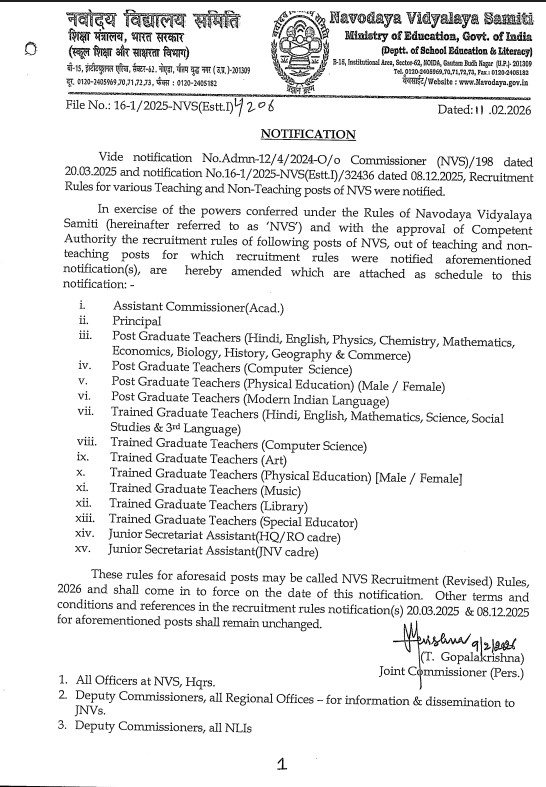
NVS Recruitment Rules for Various Teaching and Non-Teaching Posts
The Navodaya Vidyalaya Samiti (NVS) is one of India’s most respected autonomous educational organisations operating under the Ministry of Education. It administers the chain of Jawahar Navodaya Vidyalayas (JNVs), residential schools aimed at nurturing talented students from rural and remote areas. To run this vast network of schools effectively, NVS regularly recruits professionals for both teaching and non-teaching roles. But behind every recruitment drive lies a comprehensive set of recruitment rules that govern eligibility, qualifications, age limits, pay scales and selection procedures. The most recent revision of these rules, issued in early February 2026, has brought important changes that aspirants need to understand before applying for future positions.
At its core, the recruitment framework for NVS is intended to ensure fairness, transparency and merit-based selection. These rules are not just administrative formalities; they define who can apply, how they will be assessed and what they can expect in terms of career progression. In recent years, NVS has updated these regulations to align with evolving educational standards and workforce expectations. The revised rules cover both academic roles such as Post Graduate Teachers (PGTs) and Trained Graduate Teachers (TGTs), as well as administrative and support positions like Junior Secretariat Assistants and other non-teaching posts.
Understanding the Scope of NVS Recruitment Rules
The updated recruitment rules issued in February 2026 apply to a broad spectrum of posts for which earlier regulations were published in 2025. This includes positions covered under notifications issued in March 2025 and December 2025. The organising principle behind the revisions is to consolidate and clarify eligibility criteria while maintaining the core standards laid down in previous frameworks.
For teaching posts, the rules specifically address roles like:
Post Graduate Teachers (PGTs) in subjects including Hindi, English, Physics, Chemistry, Mathematics, Biology, History, Geography, Economics, Commerce, Computer Science, Physical Education and Modern Indian Languages.
Trained Graduate Teachers (TGTs) across major disciplines such as Social Studies, Science, Mathematics, Languages, Computer Science, Art, Music and Special Education.
Leadership roles including Principal and Assistant Commissioner (Academic) are also covered, with their distinct qualifications and experience criteria.
For non-teaching posts, the scope includes roles that support the operation of JNVs and NVS headquarters or regional offices. These posts — such as Junior Secretariat Assistant (JSA) — fall under both administrative and operational cadres. The detailed rules spell out specifications for each post in terms of educational background, age limits, pay scale, mode of recruitment (whether through competitive examination, direct hiring or promotion), and probation conditions where applicable.
Eligibility Criteria: What Candidates Must Know
One of the most fundamental components of recruitment rules is eligibility — the conditions a candidate must satisfy to be considered for a post. For teaching positions, academic qualifications are central. Generally, PGT and TGT roles require degrees in the relevant subject with minimum marks plus a Bachelor of Education (B.Ed) or equivalent teaching licence. These detailed educational requirements are articulated in the official rule document that candidates must consult before applying.
Moreover, NVS’ approach reflects modern educational needs. For example, in previous updates, the rules broadened certain eligibility norms for PGTs and TGTs to include diverse academic backgrounds (while maintaining core teaching qualifications) and also emphasised digital literacy as an important competency for candidates. Although these specifics need verification in the current official PDF, aspirants are strongly advised to stay updated on such competencies integrated into eligibility norms.
For non-teaching jobs, eligibility varies drastically based on the nature of the post:
Administrative roles such as JSA often require at least a Class XII pass or equivalent with specific typing speed competencies in English or Hindi.
Support roles like Lab Attendant or Multi-Tasking Staff have lower educational thresholds (for example, a 10th or 12th pass with relevant certifications) and a focus on practical skills.
Some specialised roles — for example, Female Staff Nurse — require professional qualifications such as a B.Sc in Nursing and registration with a nursing council along with relevant experience.
Age limits for each position are clearly laid out in the rules and often follow government norms for reservation and relaxation. Commonly candidates in reserved categories (SC/ST/OBC/PwBD and others) receive age relaxations, consistent with central employment policies.
Selection Process & Pay Scales
NVS typically follows a merit-based selection process, usually involving a combination of written tests and interviews or skill tests. For teaching posts, candidates may go through written competitive examinations followed by interviews or demonstration tests. For non-teaching roles, skill and typing tests are common in addition to paper-based exams. The exact method varies by post as per the rules.
A standout feature of the recruitment rules is the definition of pay scales under the 7th Central Pay Commission structure. Teaching posts like PGT and TGT fall into structured pay levels (for instance, Level 8 for PGT and Level 7 for TGT), while leadership roles like Principal and Assistant Commissioner are placed in higher pay levels commensurate with their responsibilities. Non-teaching posts range from Level 1 to Level 10 depending on role complexity, responsibilities, and required qualifications. These defined pay levels offer transparency and help candidates assess the financial aspects of each position before applying.
Why These Rules Matter to Aspirants
Understanding the recruitment rules is not merely academic — it directly shapes your preparation, application strategy and long-term career planning within NVS. For example, recognising that digital literacy and subject qualification standards are emphasised helps candidates prioritise their skill development early. Knowing exact age limits can influence when to apply, and awareness of pay scales supports career forecasting.
Moreover, NVS’ norms often influence how teaching and non-teaching jobs are approached in other central educational bodies, making familiarity with these rules valuable even outside NVS recruitment cycles. It also ensures that aspiring educators and administrators align their educational qualifications and career goals with national standards for school governance.
Final Take aways
The revised recruitment rules for teaching and non-teaching posts of NVS represent a refreshed and structured approach to staffing Jawahar Navodaya Vidyalayas with qualified professionals. The rules encapsulate eligibility criteria, recruitment procedures, pay structures and other norms designed to uphold educational excellence in one of India’s flagship school networks. Aspiring candidates should carefully read the official notification and associated PDFs on the NVS website before applying to ensure compliance with the most updated requirements.
These regulations are not static; they evolve to meet educational demands and workforce dynamics, making it essential for applicants to stay informed through official notifications and trusted exam news sources. By doing so, candidates can navigate the recruitment process effectively and increase their chances of securing a rewarding role within NVS.

Disclaimer
The information provided in this article on “Recruitment Rules for Various Teaching and Non-Teaching Posts of NVS” is intended for general informational and educational purposes only. While every effort has been made to ensure the accuracy, relevance, and timeliness of the content, readers are advised to verify all details from the official website of the Navodaya Vidyalaya Samiti (NVS) or from authorized government notifications before making any decision related to applications, eligibility, or recruitment procedures.
Recruitment rules, eligibility criteria, age limits, pay scales, and selection processes are subject to revision by NVS and the Ministry of Education without prior notice. The article does not constitute legal advice, official confirmation, or a binding interpretation of government regulations. Any reliance you place on the information presented here is strictly at your own risk.
The website and author shall not be held responsible for any loss, error, omission, or consequences arising from the use of this information. Candidates are strongly encouraged to consult official recruitment notifications, detailed rule documents, and authentic government sources for the most accurate and updated guidance.
For more information and updates please follow the page and don’t forget to leave your comment.