
Table of Contents
Census of India 2026–27: Everything You Need to Know About Census 2027
The Census of India 2026–27 is one of the most significant national statistical exercises being undertaken by the Government of India. Officially designated as Census 2027, the exercise has entered its first phase during 2026, with the Houselisting and Housing Census being conducted across States and Union Territories according to their respective schedules. The second phase, known as Population Enumeration, is scheduled mainly for February 2027. The Census is being conducted by the Office of the Registrar General and Census Commissioner, India, under the Ministry of Home Affairs. (Press Information Bureau)
The Census is far more than a simple exercise of counting people. It creates a detailed statistical picture of the country and provides essential information for government planning, public administration, infrastructure development, welfare programmes, education, healthcare, housing and numerous other areas. The upcoming Census is particularly important because it comes after a considerable gap following the 2011 Census and at a time when India is experiencing rapid demographic, economic, technological and social changes.
Census 2026: The First Phase
The first phase of Census 2027 is the Houselisting and Housing Census (HLO). This phase is being conducted during 2026, with the overall first-phase window extending from April to September 2026, although individual States and Union Territories have their own notified schedules. (Press Information Bureau)
During Houselisting and Housing Census, information relating to houses, households, housing conditions, amenities and assets is collected. Household particulars, including the name and sex of the head of the household, are among the information covered in this phase. The notified questions also provide for three categories for the sex of the head of household: Male, Female and Transgender. (Press Information Bureau)
This information will create the foundation for the subsequent Population Enumeration phase. Enumerators are required to visit households within their allotted areas so that the Census can cover the population comprehensively.
Census 2027: The Second Phase
The second phase is Population Enumeration, in which information concerning individual members of households will be collected. The Government has scheduled the main Population Enumeration for February 2027, while special arrangements apply to Ladakh and specified snow-bound areas of Jammu & Kashmir, Himachal Pradesh and Uttarakhand because of their geographical and climatic conditions. (Press Information Bureau)
The second phase is expected to provide updated information on India’s population and its demographic and socio-economic characteristics. Such information is important for understanding population distribution, migration, education, employment and other characteristics of India’s people.
India’s First Digital Census
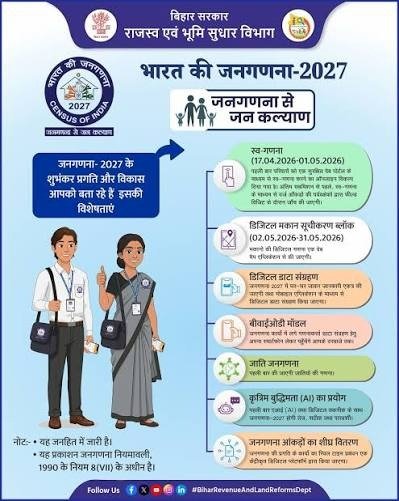
One of the most remarkable features of Census 2027 is its transition to digital data collection. The Government has described it as India’s first Census using digital means for data collection. Enumerators will use mobile applications to collect information, while digital systems will support monitoring, management and processing. (Press Information Bureau)
The digital approach is expected to make the Census process more efficient and reduce dependence on physical paperwork. The official Census infrastructure includes mobile applications, the Census Management and Monitoring System and other digital platforms. Offline data collection capability has also been incorporated into the mobile applications so that field operations can continue in areas where connectivity may be limited. (Press Information Bureau)

Self-Enumeration Facility
For the first time, the Census provides a Self-Enumeration facility, allowing eligible respondents to submit household information through an online portal. This is an important step towards increasing citizen participation and making the Census process more convenient.
However, self-enumeration does not eliminate the role of Census enumerators. Information submitted through the online facility is to be confirmed by enumerators during the Census process. The Government has also provided validation checks, tool tips and other mechanisms intended to improve the accuracy of information submitted through the digital system. (Press Information Bureau)
A Census on an Enormous Scale
India’s Census is among the largest administrative and statistical exercises in the world. The Government has approved an expenditure of ₹11,718.24 crore for Census 2027. Approximately 30 lakh field functionaries are expected to participate in the exercise. (Press Information Bureau)
Enumerators and supervisors have to undergo training so that they understand the questionnaires, digital applications, field procedures and other requirements. Government teachers and other personnel are among those who may be assigned Census duties, along with officials working at sub-district, district and State levels. (Press Information Bureau)
The scale of the exercise demonstrates the importance of accurate participation by citizens. Every household forms an important part of the national statistical record.
Importance of Census Data
Census information is essential for evidence-based governance. Governments need reliable population data to determine where new schools, hospitals, roads, transport facilities, housing projects and other public infrastructure may be required.
Population statistics also help policymakers understand patterns of urbanisation and migration. Changes in household size, living conditions, education, employment and population distribution can influence the design of government programmes.
For researchers and institutions, Census data provides an important foundation for demographic and socio-economic studies. Businesses and development organisations can also use reliable population information for planning and analysis.
Click here to visit the official website
Click here to download full circular in PDF
Caste Enumeration
Another important development associated with Census 2027 is the decision to include caste enumeration in the population enumeration phase. The Government announced that caste will be enumerated along with Population Enumeration. Detailed questions and procedures for the second phase are being notified through the official process. (Census India)
The availability of updated caste-related demographic information is expected to provide an additional statistical dimension for policy research and planning.
Privacy and Data Security
Data security and confidentiality are important components of the digital Census. The Government has stated that security measures have been incorporated during mobile-based data collection, transmission and server-level storage. Census operations are conducted under the Census Act, 1948 and the Census Rules, 1990, along with subsequent amendments. (Press Information Bureau)
Citizens should therefore provide accurate information to authorised Census personnel and cooperate with the enumeration process. Accurate information strengthens the quality of the final national database.
Click here to visit the official website
Click here to download full circular in PDF
Role of Citizens
The success of Census 2027 depends not only on technology and government machinery but also on public cooperation. Every household should cooperate with Census officials, provide correct information and ensure that the required details are supplied properly.
The introduction of Self-Enumeration provides citizens with an additional opportunity to participate digitally. At the same time, house-to-house enumeration remains an essential part of the process and is intended to ensure that people are not excluded from the Census. (Press Information Bureau)
Click here to visit the official website
Click here to download full circular in PDF
Census 2026–27 and India’s Future
India is undergoing major changes in population distribution, urban development, technology, education, migration and household structures. Updated Census information will therefore be crucial for understanding the country as it moves into a new phase of development.
The first phase being conducted in 2026 will establish important information about houses and households, while the Population Enumeration phase will provide information about individual members of the population. Together, these phases are intended to create a comprehensive statistical foundation for the country.
Conclusion
The Census of India 2026–27, officially known as Census 2027, represents a major transformation in India’s population data system. The 2026 Houselisting and Housing Census marks the beginning of the exercise, while Population Enumeration will follow mainly in 2027.
The use of mobile applications, digital monitoring, Self-Enumeration and enhanced data-security systems makes this Census different from earlier exercises. At the same time, its traditional purpose remains unchanged: to create a reliable statistical picture of India and its people.
For citizens, participation in the Census is more than a formal obligation—it is a contribution to the country’s future planning. Every household counted, every accurate detail recorded and every citizen included helps create a stronger statistical foundation for a better-planned India.
Note: This article is intended for general informational purposes. Readers should refer to official Government of India and Census authorities for the latest State/UT-specific schedules, instructions, notifications and official Census information.
Click here to visit the official website
Click here to download full circular in PDF
For more information and updates please follow the page and don’t forget to leave your comment.