
Acceptance of Gifts
Acceptance of gifts—can raise big questions. Why? Because perception matters just as much as reality.
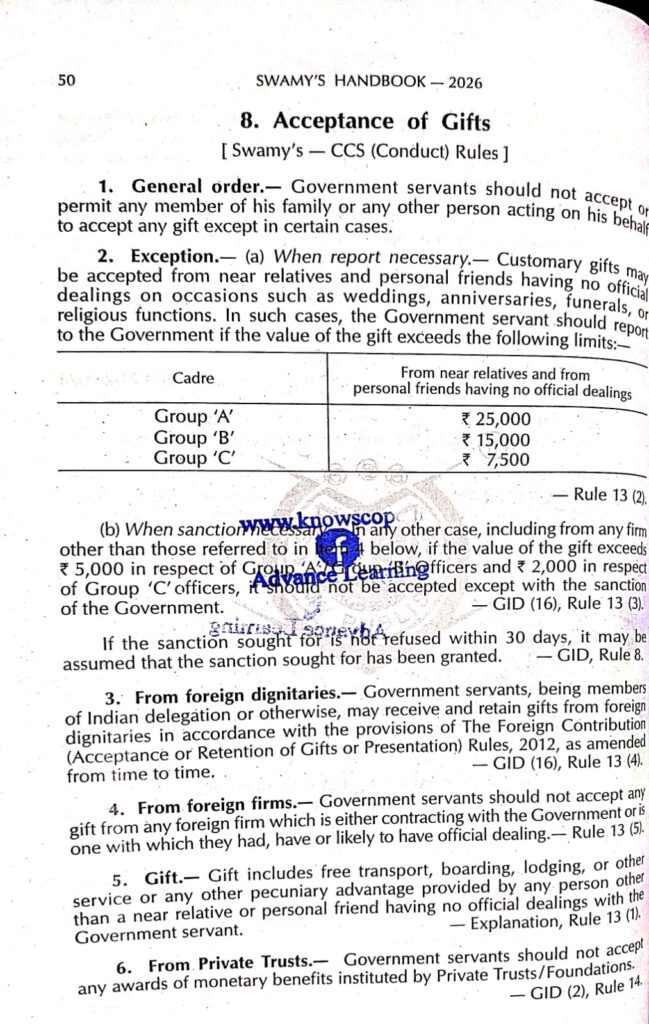
Under the Swamy’s Handbook 2026, the rules relating to acceptance of gifts are clearly explained with reference to the Central Civil Services (Conduct) Rules. These provisions aim to ensure transparency, integrity, and fairness in public administration.
Why Gift Rules Matter in Public Service
Imagine a government officer accepting an expensive watch from a contractor. Even if no favour is granted, doesn’t it look suspicious? Exactly. The rules exist to prevent conflicts of interest and maintain public confidence.
Legal Framework Governing Gift Acceptance
The primary regulation is the Central Civil Services (Conduct) Rules, as interpreted and explained in Swamy’s Handbook. These rules define what is allowed, what requires reporting, and what is strictly prohibited.
Overview of Swamy’s Handbook 2026
Importance of Swamy’s Compilation
For decades, Swamy’s Handbook has served as a practical guide for Central Government employees. It simplifies complex service rules into understandable language.
Key Updates in 2026 Edition
The 2026 edition emphasizes transparency, digital transactions, and stricter vigilance monitoring, especially regarding financial gifts and foreign hospitality.
Definition of “Gift” Under Conduct Rules
What Constitutes a Gift?
A “gift” includes any gratuity, monetary benefit, free service, or pecuniary advantage received without consideration. It may include:
Cash
Valuable items
Free travel
Costly hospitality
Items Excluded from the Definition
Casual meals or simple refreshments during official meetings generally do not count as gifts. However, lavish entertainment certainly does.
General Prohibition on Acceptance of Gifts
Gifts from Interested Persons
A Central Government employee shall not accept gifts from persons having official dealings with them. This includes contractors, suppliers, or vendors.
Gifts from Subordinates
Accepting gifts from subordinates is strictly discouraged. Why? Because it creates pressure and affects workplace fairness.
Accepting Gifts on Occasions Like Weddings and Festivals
Special occasions are treated differently.
Monetary Limits for Near Relatives
On weddings, anniversaries, or religious ceremonies, gifts from near relatives are generally allowed without strict monetary limits, provided they are customary.
Monetary Limits for Others
If the value exceeds prescribed limits (as notified by the Government from time to time), reporting to the competent authority becomes mandatory.
Think of it like a speed limit. Drive within it, and you’re fine. Cross it, and paperwork begins.
Reporting Requirements and Intimation Rules
When Prior Sanction is Required
If a gift exceeds the prescribed monetary ceiling from non-relatives, prior sanction may be required.
When Intimation is Sufficient
In many cases, simple written intimation within a specified period suffices, especially for wedding gifts.
Gifts from Foreign Sources
Applicability of Foreign Contribution Rules
Foreign gifts are sensitive. Acceptance may fall under regulations governing foreign contributions and require clearance.
Handling of Expensive Gifts
Expensive gifts received in official capacity from foreign dignitaries are often required to be deposited with the Government (Toshakhana rules).
Acceptance of Free Transport, Boarding, and Hospitality
Private vs Official Visits
Free hospitality during private visits is usually restricted. During official tours, it must comply with government norms.
Exceptions for Close Relatives
Hospitality from close relatives is generally permissible, provided no official interest is involved.
Gifts Received in Official Capacity
Trophies and Mementos
Small mementos, plaques, and certificates presented during official functions are generally allowed.
Deposit with Government
Costly items received officially must often be deposited with the department.
Cash Gifts and Digital Transfers
Restrictions on Cash Acceptance
Cash gifts are viewed with suspicion. Large amounts are subject to strict reporting.
Transparency in Financial Gifts
With digital transactions becoming common, even online transfers must follow conduct rules.
Disciplinary Consequences of Violations
Minor vs Major Penalties
Violation of gift rules can result in:
-
Censure
-
Withholding of increments
-
Suspension
-
Dismissal in serious cases
Case Scenarios
If an officer accepts a high-value gift from a contractor without reporting it, disciplinary proceedings may follow.
Role of Vigilance and Ethics in Gift Acceptance
Preventing Corruption
Gift rules act as preventive medicine against corruption. They stop problems before they start.
Maintaining Public Trust
Public servants are custodians of public money. Transparency ensures faith in governance.
Practical Examples for Better Understanding
Wedding Scenario
An employee receives ₹40,000 as a wedding gift from a colleague. If within limits, intimation may suffice.
Festival Scenario
Receiving sweets during Diwali? That’s fine. Receiving a gold chain? That’s reportable.
Contractor Offering Gift
An expensive smartphone from a contractor? Strictly prohibited.
Frequently Misunderstood Aspects
Token Gifts
Low-value customary gifts may be allowed but should not create obligation.
Gifts During Transfers
Farewell gifts must be modest and usually from a group, not individuals.
Best Practices for Central Government Employees
When in doubt, report it. Transparency protects you. Keep records. Follow limits. Seek clarification from your department.
Think of gift rules like guardrails on a mountain road—they don’t restrict your journey; they keep you safe.
Conclusion
Acceptance of gifts by Central Government staff is not entirely prohibited—but it is carefully regulated. As explained in Swamy’s Handbook 2026, the emphasis is on integrity, transparency, and avoidance of conflict of interest. The rules are simple in spirit: avoid obligation, avoid suspicion, and avoid compromise. When public trust is at stake, even small gestures matter. Follow the limits, report when required, and always choose transparency over convenience.
FAQs
1. Can a Central Government employee accept wedding gifts?
Yes, from relatives and friends, within prescribed limits and with necessary intimation.
2. Is accepting cash gifts allowed?
Only within permitted limits and subject to reporting requirements.
3. Are festival gifts like sweets allowed?
Yes, if nominal and customary.
4. What happens if gift rules are violated?
Disciplinary action ranging from censure to dismissal may be initiated.
5. Are foreign gifts treated differently?
Yes, expensive foreign gifts often require deposit with the Government.
Click here to download the full notification in PDF
Disclaimer
The information provided in this article is intended for general informational and educational purposes only. While every effort has been made to ensure accuracy based on the provisions explained in Swamy’s Handbook 2026 and the relevant Central Civil Services (Conduct) Rules, this content should not be treated as official legal advice or a substitute for the original government notifications, office memoranda, or statutory rules.
Service rules, monetary limits, and reporting requirements may be amended by the Government of India from time to time. Readers are strongly advised to refer to the latest official circulars, departmental instructions, and authoritative publications before taking any decision based on the content of this article.
The author and publisher shall not be responsible for any loss, liability, or consequences arising from the use or interpretation of the information presented herein. For case-specific clarification, employees should consult their administrative department, vigilance authority, or competent disciplinary authority.
For more information and updates please follow the page and don’t forget to leave your comment.