
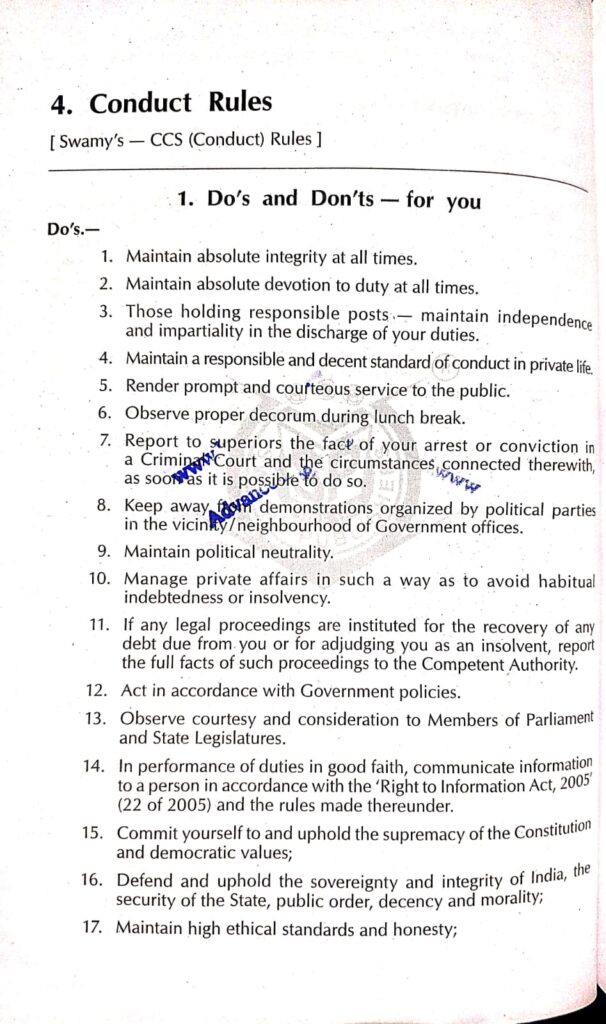
Conduct Rules as per Swamy’s Handbook 2026 – A Complete Guide for Government Employees
Introduction to Conduct Rules
If you are a government employee, conduct rules are not just formal guidelines printed in a book—they are the invisible framework shaping your professional life. They define what you can do, what you should avoid, and how you are expected to behave both inside and outside the office.
The Conduct Rules, as explained in Swamy’s Handbook 2026, primarily refer to the Central Civil Services (Conduct) Rules, 1964, along with updated amendments. These rules ensure discipline, transparency, and accountability in public service.
Why Conduct Rules Matter in Government Service
Imagine public service as a bridge between the government and citizens. Now ask yourself—what happens if the bridge is weak? Trust collapses. Conduct rules ensure that this bridge remains strong.
They maintain integrity, prevent misuse of authority, and protect the reputation of the government machinery.
Legal Foundation of Conduct Rules
The Conduct Rules are framed under Article 309 of the Constitution of India. They are legally binding. Violations can result in disciplinary proceedings under the CCS (CCA) Rules.
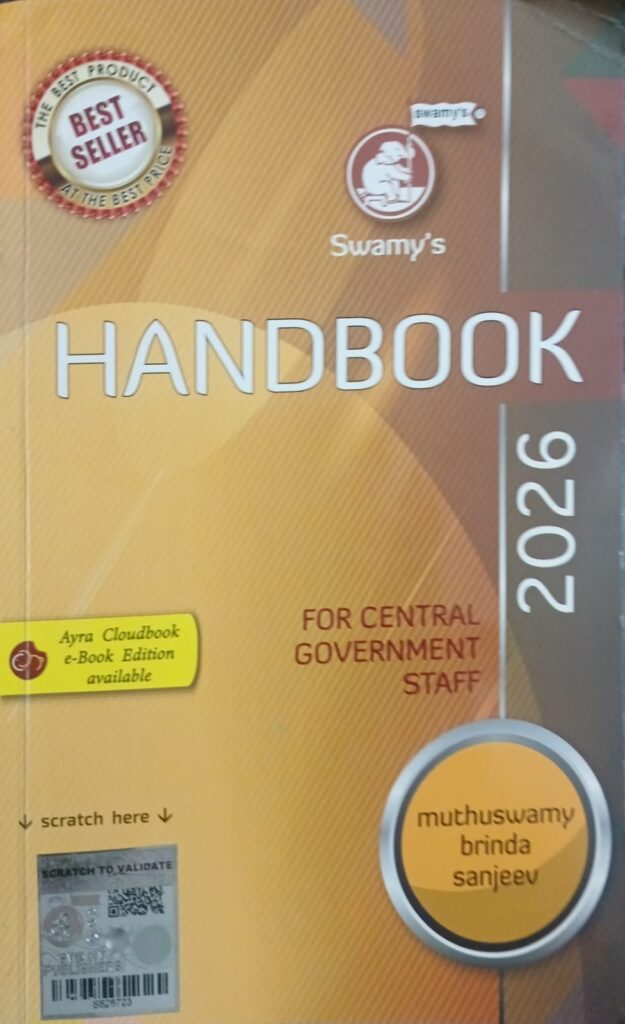
Overview of Swamy’s Handbook 2026
What is Swamy’s Handbook?
Swamy’s Handbook is considered a practical guide for Central Government employees. It compiles service rules, orders, clarifications, and case laws in one place. For many employees, it acts like a ready reckoner.
Importance for Central Government Employees
Whether you are newly appointed or nearing retirement, Swamy’s Handbook simplifies complex provisions. It translates legal jargon into understandable guidance.
Core Principles of Conduct Rules
Integrity and Absolute Devotion to Duty
The first and foremost expectation? Absolute integrity.
Every government servant must:
Maintain integrity
Devote themselves fully to duty
Avoid actions unbecoming of a government servant
Integrity is not optional. It is the backbone of public service.
Maintaining Public Trust
Public confidence is fragile. One careless act can damage years of credibility. Conduct rules ensure that personal interests never override public duty.
General Conduct Expectations
Professional Behavior
Employees must maintain discipline, punctuality, and respect for hierarchy. Disobedience or insubordination can attract disciplinary action.
Avoidance of Misconduct
Misconduct includes corruption, insubordination, misuse of power, and moral turpitude. Even behavior outside office that damages the image of service may be questioned.
Restrictions on Political Activities
Participation in Political Events
Government employees cannot:
Join political parties
Contest elections (except as permitted)
Participate in political campaigns
The service demands neutrality.
Public Statements and Criticism
Criticizing government policies publicly without authorization is prohibited. Public servants must exercise restraint, especially on public platforms.
Rules Regarding Media and Social Media
Public Communication Guidelines
In today’s digital age, social media can be a trap. Posting official matters without authorization is strictly prohibited.
Employees must seek prior approval before publishing articles related to official work.
Sharing Official Information
Confidential information cannot be disclosed. The Official Secrets Act may apply in serious cases.
Acceptance of Gifts and Hospitality
Permissible Limits
Gifts beyond prescribed monetary limits must be reported. Accepting lavish hospitality from private entities linked to official dealings is prohibited.
Reporting Requirements
Annual intimation of gifts above threshold limits is mandatory.
Transparency protects you from suspicion.
Click here to download the full notification in PDF
Financial Conduct and Property Returns
Declaration of Assets
Government servants must submit annual property returns detailing movable and immovable assets.
Why? To ensure financial transparency and prevent corruption.
Transactions and Investments
Certain high-value transactions require prior intimation or sanction. Speculative trading is discouraged.
Conflict of Interest
Definition and Examples
Conflict of interest arises when personal interests clash with official duties. For example:
Awarding contracts to relatives
Using position for private gain
Preventive Measures
Disclosure is key. When in doubt, inform your department.
Private Employment and Outside Work
Prior Sanction Requirement
No government employee can engage in private trade or employment without prior sanction.
Teaching and Writing Exceptions
Academic lectures or writing books may be allowed, provided they do not interfere with official duties and prior approval is obtained where necessary.
Conduct in Personal Life
Bigamy and Marital Conduct
Contracting a second marriage during the subsistence of the first marriage without permission is prohibited (unless personal law permits and government approval is obtained).
Moral Turpitude
Criminal conviction for moral turpitude can lead to dismissal.
Your private life is not entirely private when it affects public image.
Prohibition of Sexual Harassment
Definition and Scope
Sexual harassment includes unwelcome physical contact, advances, or remarks of sexual nature.
Complaint Mechanism
Internal Complaints Committees (ICC) handle such cases as per the POSH Act. Strict penalties apply.
Participation in Strikes and Demonstrations
Legal Implications
Government employees cannot participate in strikes that disrupt public services.
Disciplinary Action
Participation may lead to suspension or disciplinary proceedings.
Penalties for Violation of Conduct Rules
Minor Penalties
Censure
Withholding increments
Recovery from pay
Major Penalties
Reduction in rank
Compulsory retirement
Removal or dismissal from service
The severity depends on the gravity of misconduct.
Practical Tips for Compliance
Staying Updated
Rules evolve. Always refer to updated editions like Swamy’s Handbook 2026.
Maintaining Transparency
When unsure, disclose. Transparency is your safety net.
Conclusion
Conduct Rules as per Swamy’s Handbook 2026 are not just regulatory formalities—they are the ethical compass of government service. They define professionalism, integrity, and accountability. In a system built on public trust, every action matters.
Think of these rules as guardrails on a mountain road. They may seem restrictive, but they keep you safe from dangerous falls. Follow them sincerely, and your career will remain secure, respected, and stable.
FAQs
1. Are Conduct Rules applicable after office hours?
Yes. Behavior outside office that affects the image of service can invite action.
2. Is prior permission required before publishing a book?
If it relates to official duties or sensitive matters, prior sanction is necessary.
3. Can a government employee contest elections?
Generally no, unless they resign or obtain proper clearance as per rules.
4. What happens if property returns are not submitted?
Failure to submit property returns can lead to disciplinary proceedings.
Disclaimer
The information provided in this article on “Conduct Rules as per Swamy’s Handbook 2026” is intended for general informational and educational purposes only. While every effort has been made to ensure accuracy and clarity, the content should not be treated as an official interpretation of government rules or a substitute for the original statutory provisions.
Readers are advised to refer to the relevant official notifications, government orders, circulars, and the latest edition of Swamy’s Handbook for precise and updated information. Service rules are subject to amendments, clarifications, and judicial interpretations from time to time, which may not be fully reflected here.
This article does not constitute legal advice. For specific cases, disciplinary matters, or procedural clarification, employees should consult their department, administrative authority, or a qualified legal professional.
The author and publisher shall not be held responsible for any loss, action, or decision taken based on the information presented in this article.
For more information and updates please follow the page and don’t forget to leave your comment.