
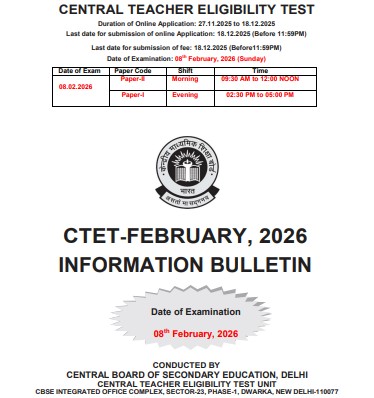
Table of Contents
Unique Article on CTET FEBRUARY 2026 PART II – Detailed Syllabus and Preparation Insight
The CTET February 2026 Part II examination is a crucial milestone for aspiring teachers who wish to teach Classes VI to VIII in central government schools and other institutions that recognize the CTET qualification. This paper is designed to assess not only subject knowledge but also a candidate’s understanding of pedagogy, child psychology, and effective teaching strategies at the upper primary level. CTET Part II goes beyond rote learning and focuses on how teachers think, plan, and respond to diverse classroom situations. Understanding the detailed syllabus is the first step toward smart and focused preparation.
Click here to go to the official website
Click here to download the full notification in PDF
A major component of CTET February 2026 Part II is Child Development and Pedagogy, which carries 30 questions. This section emphasizes the understanding of the elementary school child and the learning process. Topics such as the concept of development and its relationship with learning help candidates grasp how children grow cognitively, emotionally, and socially. Principles of child development, along with the influence of heredity and environment, highlight that learning is shaped by both biological and social factors. Socialization processes involving teachers, parents, and peers underline the role of the social world in shaping a child’s personality. The theories of Piaget, Kohlberg, and Vygotsky are central here, focusing on cognitive development, moral development, and socio-cultural learning. Modern educational ideas like child-centered and progressive education, multiple intelligence, language and thought, and intelligence as a multidimensional construct are also tested. Additionally, this section covers gender as a social construct, diversity in classrooms, assessment for learning versus assessment of learning, and continuous and comprehensive evaluation. Candidates are also assessed on their ability to frame appropriate questions to assess readiness levels, enhance critical thinking, and evaluate learner achievement.
Closely connected to this is the concept of inclusive education and understanding children with special needs, which carries 5 questions. This part evaluates a teacher’s sensitivity and awareness toward learners from diverse and disadvantaged backgrounds. It includes addressing the needs of children with learning difficulties, impairments, and special educational requirements. Special attention is given to talented, creative, and specially-abled learners, ensuring that future teachers are equipped to create inclusive classrooms where every child gets equal opportunities to learn and grow.

The Learning and Pedagogy section, consisting of 10 questions, focuses on how children think and learn, and why some children fail to achieve expected school performance. It explores learning as a social activity influenced by the classroom environment and broader social context. The child is viewed as a problem solver and a scientific investigator, encouraging inquiry-based learning. Understanding children’s errors as meaningful steps in the learning process is a key idea here. Topics like cognition and emotions, motivation, and factors contributing to learning—both personal and environmental—are essential for developing effective teaching practices.
Click here to go to the official website
Click here to download the full notification in PDF
Another significant part of CTET Part II is Language I, which includes 30 questions. This section tests language proficiency and pedagogical understanding. Language comprehension involves reading unseen passages, including prose, drama, and poetry, followed by questions on comprehension, inference, grammar, and verbal ability. The pedagogy of language development focuses on learning and acquisition, principles of language teaching, and the role of listening and speaking. It also examines how children use language as a tool for communication, the role of grammar in language learning, and challenges of teaching language in diverse classrooms. Evaluation of language skills—listening, speaking, reading, and writing—along with remedial teaching strategies, forms an important part of this section.
Similarly, Language II also carries 30 questions and follows a parallel structure. It includes comprehension passages and pedagogy of language development. This section ensures that teachers are proficient in a second language and can effectively teach it while addressing language errors, disorders, and multilingual classroom realities. Teaching-learning materials such as textbooks, multimedia resources, and multilingual tools are also emphasized.
The Mathematics and Science section consists of 60 questions and is divided equally between Mathematics and Science. In Mathematics, 20 questions are based on content such as number systems, algebra, geometry, mensuration, and data handling. The remaining 10 questions focus on pedagogical issues like the nature of mathematics, logical thinking, language of mathematics, evaluation methods, remedial teaching, and common problems in teaching mathematics. This ensures that candidates not only know mathematical concepts but also understand how to teach them effectively.
The Science portion also includes 20 content-based questions covering topics such as food, materials, the world of living, moving things, natural phenomena, electric circuits, and natural resources. The pedagogy section tests understanding of the nature and structure of science, aims and objectives of science education, scientific methods like observation and experimentation, innovation, use of teaching aids, evaluation across cognitive, psychomotor, and affective domains, and remedial teaching.
The final major component is Social Studies/Social Sciences, which carries 60 questions. Out of these, 40 questions are based on content from History, Geography, and Social and Political Life. History topics range from early societies and civilizations to colonialism, the national movement, and India after independence. Geography includes earth and environment, resources, agriculture, and human settlements. Social and Political Life covers democracy, government, constitution, media, gender, social justice, and marginalized communities. The pedagogical issues section focuses on the nature of social science, classroom processes, critical thinking, enquiry-based learning, use of sources, project work, and evaluation methods.
In conclusion, CTET February 2026 Part II is a comprehensive examination that evaluates a teacher’s readiness to handle upper primary classes with confidence and competence. It emphasizes understanding learners, inclusive education, subject knowledge, and effective pedagogy. Candidates who prepare with conceptual clarity, focus on NCERT-based content, and understand teaching methodologies will be well-positioned to succeed. CTET Part II is not just an exam; it is a foundation for becoming a reflective, inclusive, and impactful educator.
DISCLAIMER
The information provided in this article on CTET February 2026 Part II is published purely for general informational and educational purposes. Every effort has been made to present accurate and updated details based on the prescribed syllabus, previous examination patterns, and publicly available sources. However, the syllabus structure, exam pattern, number of questions, and other related details are subject to change at the discretion of the Central Board of Secondary Education (CBSE).
This article does not represent any official statement, endorsement, or communication from CBSE or any government authority and should not be treated as a substitute for official notifications or professional advice.
For more information and updates, please follow the page and don’t forget to leave your comment.