
Table of Contents
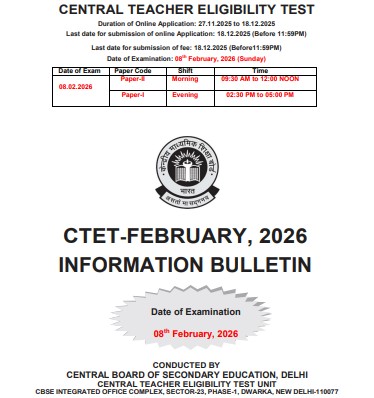
Introduction to CTET February 2026 Part I
If teaching young minds is your dream, then CTET February 2026 Part I could be your golden ticket. This exam is not just another test; it’s a gateway that opens doors to a stable, respectable, and impactful career in primary education. Designed for candidates aspiring to teach Classes I to V, CTET Part I evaluates not only subject knowledge but also teaching aptitude and child-centric understanding.
What is CTET and Why It Matters
The Central Teacher Eligibility Test, commonly known as CTET, is a national-level examination conducted to maintain teaching standards across India. Clearing CTET is like earning a quality stamp that validates your readiness to stand in a classroom and shape the future generation.
Click here to go to the official website
Click here to download the full notification in PDF
Role of CTET in Teaching Careers
CTET qualification is mandatory for teachers seeking jobs in Central Government schools such as Kendriya Vidyalayas, Navodaya Vidyalayas, and other schools under central administration. Many state governments also consider CTET scores during recruitment, making it a powerful credential.
Overview of CTET February 2026 Examination
Conducting Authority
CTET February 2026 is conducted by the Central Board of Secondary Education (CBSE), an authority known for maintaining transparency and standardized evaluation methods.
Mode of Examination
The examination is conducted in Computer-Based Test (CBT) mode, ensuring a smooth and efficient assessment process across multiple exam centers in India.
Understanding CTET Part I
Classes Covered Under Part I
CTET Part I is specifically meant for candidates aspiring to teach Classes I to V. The focus is on foundational learning, child development, and basic subject concepts essential for primary education.
Eligibility Criteria for CTET February 2026 Part I
Educational Qualifications
Candidates must have passed Senior Secondary (or equivalent) with at least 50% marks and completed or be appearing in a 2-year Diploma in Elementary Education or equivalent qualification recognized by NCTE.
Minimum Percentage Requirements
Relaxation in qualifying marks is available for reserved categories as per government norms, making the exam inclusive and accessible.
Age Limit and Relaxation Rules
There is no upper age limit to appear for CTET. This flexibility allows even experienced individuals or career switchers to pursue teaching without age barriers.
Application Process for CTET February 2026
Online Registration Steps
The application process is entirely online. Candidates need to register, fill in personal and academic details, upload documents, and pay the application fee through the official portal. Accuracy during form filling is crucial to avoid rejection.
Important Dates to Remember
While exact dates are announced in the official notification, candidates should keep an eye on application start dates, last date for fee payment, admit card release, and examination date to stay ahead.
Exam Pattern of CTET Part I
Subjects Included
CTET Part I consists of five sections: Child Development and Pedagogy, Language I, Language II, Mathematics, and Environmental Studies. Each section tests both conceptual clarity and teaching methodology.
Marking Scheme
The exam comprises 150 multiple-choice questions carrying one mark each. There is no negative marking, which encourages candidates to attempt all questions confidently.
Click here to go to the official website
Click here to download the full notification in PDF
Syllabus Overview for CTET Part I
The syllabus is aligned with the NCERT curriculum for primary classes. It emphasizes understanding child psychology, inclusive education, and foundational subject knowledge rather than rote learning.
Language Paper Details
Candidates must choose two languages. Language I focuses on the medium of instruction, while Language II tests comprehension and communication skills in a different language.
Preparation Strategy for CTET February 2026 Part I
Smart Study Tips
Preparation should be strategic rather than stressful. Understanding concepts, practicing previous year questions, and taking mock tests can significantly boost confidence. Think of preparation as building blocks—strong basics lead to stable success.
Recommended Books and Resources
NCERT textbooks from Classes I to V are the backbone of preparation. Along with them, standard CTET preparation guides and online mock tests help in exam-oriented practice.
Importance of CTET Certificate Validity
The CTET certificate is valid for a lifetime, which means once you qualify, you don’t need to retake the exam. This makes CTET a one-time investment with long-term returns.
Career Opportunities After Qualifying CTET Part I
After clearing CTET Part I, candidates can apply for teaching positions in central schools, private institutions, and government-aided schools. It also boosts credibility during interviews and recruitment processes.
Common Mistakes to Avoid
Ignoring Child Development and Pedagogy, skipping mock tests, and relying solely on memorization are common pitfalls. Balanced preparation is the key to success.
Conclusion
CTET Paper I Syllabus Part I is more than an exam—it’s a stepping stone toward a fulfilling teaching career. With the right approach, consistent practice, and conceptual clarity, qualifying CTET becomes an achievable goal. For those passionate about nurturing young learners, this exam marks the beginning of a meaningful professional journey.
Frequently Asked Questions (FAQs)
Q1. Is CTET February 2026 Part I compulsory for primary teachers?
Yes, CTET Part I is mandatory for teaching Classes I to V in central government schools.
Q2. Can I appear for CTET Part I multiple times?
Yes, there is no restriction on the number of attempts.
Q3. Is there negative marking in CTET Part I?
No, CTET does not have negative marking.
Q4. What is the validity of the CTET certificate?
The CTET certificate is valid for a lifetime.
Q5. Can final-year diploma students apply for CTET February 2026?
Yes, candidates appearing in the final year of eligible courses can apply.
DISCLAIMER
The information provided in this article on CTET February 2026 Part I is intended solely for general informational and educational purposes. While every effort has been made to ensure the accuracy, relevance, and reliability of the content at the time of writing, the details mentioned here are based on publicly available information, previous examination trends, and expected guidelines.
This content does not represent any official communication from CBSE or any government authority and should not be treated as a substitute for official announcements or professional guidance.
For more information and updates, please follow the page and don’t forget to leave your comment.