
Probation Rules as per Swamy’s Handbook 2026
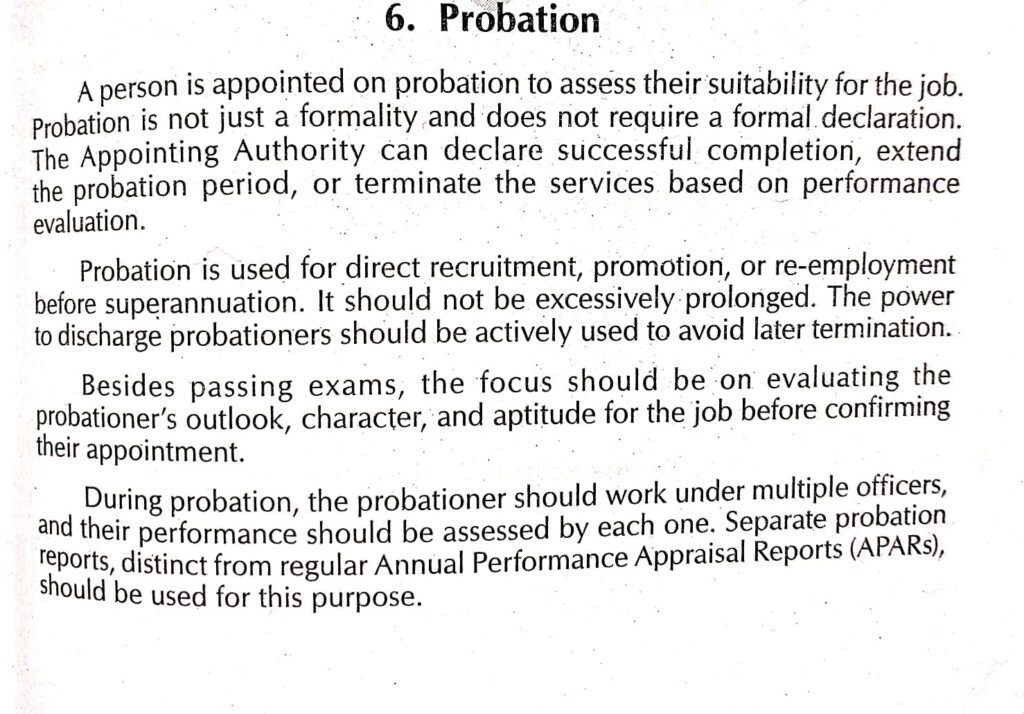
The probation rules discussed here are based on Swamy’s Handbook 2026, a widely relied-upon reference for Central Government service matters.
When you step into a government job, it feels like crossing a major milestone. But here’s the catch—you’re not fully “permanent” yet. You’re on probation. Think of probation as a test drive. The government wants to see whether you truly fit the role before confirming you.
Meaning of Probation
Probation is a trial period during which a newly appointed employee’s performance, conduct, and suitability are assessed. It’s not just a formality. It’s a structured evaluation phase governed by detailed service rules.
Purpose of Probation Period
Why does probation exist? Simple. It ensures efficiency in public service. The administration checks whether you can handle responsibilities, follow conduct rules, and adapt to the system. It protects both the organization and the employee.
Matters
This handbook acts like a compass for government employees. From appointments to retirement, it explains service conditions in clear terms. When it comes to probation, it lays down precise guidelines.
Applicability to Central Government Employees
The probation rules primarily apply to Central Government employees. However, many State Governments follow similar principles.
Duration of Probation
Standard Probation Period
Typically, probation lasts two years for direct recruits. However, this may vary depending on service rules for specific cadres.
Extension of Probation
What if performance isn’t satisfactory? The appointing authority may extend probation. This isn’t automatic—it depends on evaluation.
Maximum Time Limit for Extension
Probation cannot be extended endlessly. Rules generally prescribe a maximum period beyond which the employee must either be confirmed or discharged.
Confirmation After Probation
Confirmation is not automatic. Just completing two years doesn’t guarantee it.
Conditions for Confirmation
An employee must:
Complete the prescribed probation period.
Pass required departmental exams.
Maintain satisfactory conduct and performance.
Receive a formal confirmation order.
Role of Performance Evaluation
Annual Performance Appraisal Reports (APARs) play a key role. If reports reflect inefficiency or misconduct, confirmation may be delayed.
Rights and Responsibilities During Probation
Duties of a Probationer
A probationer performs the same duties as a confirmed employee. There’s no relaxation in responsibility. In fact, expectations are often higher.
Conduct and Discipline Rules
All conduct rules apply fully. Misconduct during probation can lead to termination without the elaborate procedures required for confirmed employees.
Termination During Probation
This is the most sensitive aspect.
Grounds for Discharge
A probationer may be discharged for:
Unsatisfactory performance
Failure to pass exams
Lack of integrity
General unsuitability
Notice Period Requirements
Generally, termination during probation requires a notice period or pay in lieu thereof, as per service rules.
Difference Between Termination and Dismissal
Termination during probation is not considered a punishment if it is based on unsuitability. Dismissal, on the other hand, is punitive and involves disciplinary proceedings. That distinction matters legally.
Leave Rules During Probation
Admissibility of Leave
Probationers are entitled to leave as per applicable rules. However, excessive leave can raise concerns.
Impact of Long Leave on Probation
If a probationer takes long leave, especially extraordinary leave, the probation period may be extended. Why? Because assessment requires actual working time.
Probation and Seniority
Effect on Seniority After Confirmation
Once confirmed, seniority usually counts from the date of appointment, not confirmation, provided probation was completed satisfactorily.
Probation in Cases of Promotion
Probation isn’t limited to new recruits.
Probation on Promotion
Employees promoted to higher posts may also be placed on probation. This ensures suitability at the higher responsibility level.
Reversion to Previous Post
If performance is unsatisfactory, the employee can be reverted to the lower post without it being treated as a penalty.
Departmental Examinations and Training
Mandatory Exams
Many services require probationers to pass departmental exams within a specified time.
Failure to Pass Examinations
Failure may result in:
-
Extension of probation
-
Withholding of increments
-
Discharge from service in extreme cases
Legal Safeguards and Judicial Interpretation
Natural Justice Principles
Courts have clarified that if termination is stigmatic or punitive in nature, principles of natural justice must be followed. However, simple discharge for unsuitability during probation does not always require a full inquiry.
The line between “unsuitability” and “punishment” can sometimes be thin. That’s why authorities must act carefully and fairly.
Practical Tips for Employees on Probation
Let’s be practical. How do you sail smoothly through probation?
-
Understand your service rules.
-
Maintain discipline and punctuality.
-
Complete mandatory training on time.
-
Build a positive record in APARs.
-
Seek guidance from seniors.
Think of probation as planting a tree. The stronger the roots in the first two years, the taller your career will grow.
Common Misconceptions About Probation
Many believe:
-
“I can’t be removed once selected.” Not true.
-
“Probation automatically ends after two years.” Wrong.
-
“Termination during probation is always illegal.” It depends on circumstances.
Clarity saves stress.
Why Understanding Probation Rules Matters
Probation isn’t just a technical phase. It shapes your entire career. A strong probation record builds credibility. A weak one creates setbacks.
Would you build a house without checking the foundation? Of course not. Similarly, understanding probation rules protects your professional future.
Conclusion
Probation under Swamy’s Handbook 2026 is not merely a waiting period—it’s a structured evaluation process. It balances administrative efficiency with employee opportunity. While it grants authorities flexibility, it also provides safeguards against arbitrary action. For employees, the key lies in performance, integrity, and awareness of rules. Clear understanding reduces uncertainty and empowers you to navigate your early service years confidently.
FAQs
1. Is confirmation automatic after completing two years of probation?
No. Confirmation requires satisfactory performance, completion of exams, and a formal order from the competent authority.
2. Can a probationer be terminated without inquiry?
Yes, if termination is based on general unsuitability and not punitive in nature.
3. Does leave affect probation period?
Yes. Long periods of leave may result in extension of probation.
4. What happens if departmental exams are not cleared?
Probation may be extended, increments withheld, or in extreme cases, service terminated.
5. Is probation required after promotion?
In many services, yes. Promotion often comes with a fresh probation period to assess suitability for higher responsibilities.
Click here to download the full notification in PDF

Disclaimer
The information provided in this article on Probation Rules as per Swamy’s Handbook 2026 is intended for general informational and educational purposes only. While every effort has been made to ensure accuracy and clarity, the content should not be treated as official legal advice, service confirmation, or a substitute for referring directly to the relevant government rules, notifications, or circulars issued by competent authorities.
Service conditions, probation rules, and administrative procedures may vary depending on the department, cadre, amendments, or specific government orders in force at a given time. Readers are strongly advised to consult the latest official publications, departmental guidelines, or authorized legal professionals for precise interpretation and application of the rules in their individual cases.
The author and publisher disclaim any liability for decisions taken based on the information presented in this article. Readers are responsible for verifying details from authentic and updated sources before acting upon them.
For more information and updates please follow the page and don’t forget to leave your comment.