
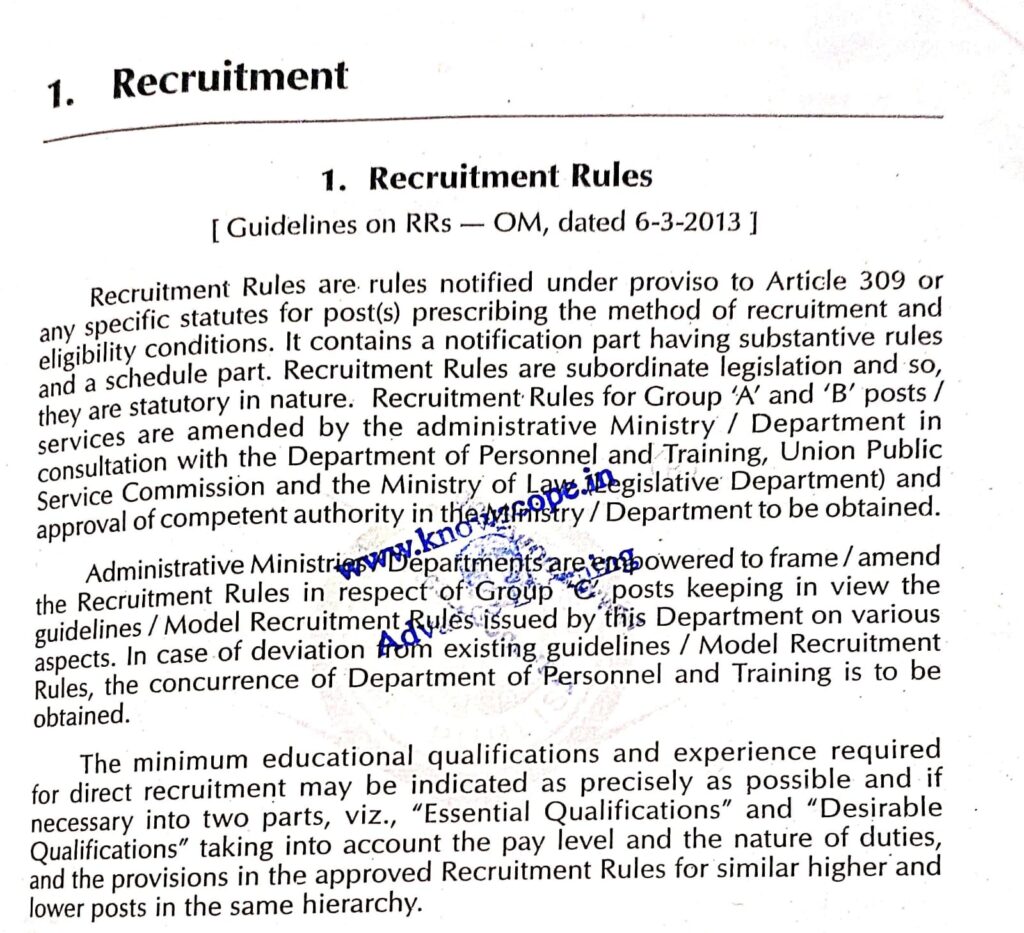
Recruitment Rules by Swamy Handbook 2026: A Complete and Practical Guide for Government Service
Recruitment in government service is not just about filling vacancies; it is about maintaining a structured, fair, and legally compliant system. Every appointment, every promotion, and every selection process must follow a defined framework known as Recruitment Rules (RRs). If you have ever wondered how government posts are structured, how eligibility criteria are decided, or how promotions are regulated, the answer lies in Recruitment Rules. And when it comes to understanding these rules in detail, Swamy Handbook 2026 remains one of the most trusted reference guides.
The Recruitment Rules by Swamy Handbook 2026 edition provides a comprehensive and updated explanation of how recruitment rules are framed, interpreted, and implemented across Central Government departments. It acts like a blueprint. Think of Recruitment Rules as the architectural design of a building. Without the design, construction becomes chaotic. Similarly, without proper RRs, recruitment can become inconsistent and legally vulnerable.
Recruitment Rules define the essential qualifications, age limits, experience requirements, method of recruitment, promotional avenues, and service conditions for each government post. These rules are notified formally and are legally binding. The Swamy Handbook compiles these scattered notifications and amendments into one practical and accessible guide.
In 2026, recruitment rules continue to evolve due to policy changes, judicial pronouncements, and administrative reforms. The Swamy Handbook 2026 reflects these updates, ensuring that departments and aspirants stay aligned with the latest provisions. From reservation policies to digital recruitment procedures, the handbook integrates modern developments while maintaining the foundation of constitutional principles.
One of the most important aspects of Recruitment Rules explained in the Swamy Handbook is the Method of Recruitment. Every government post specifies whether it will be filled through direct recruitment, promotion, deputation, absorption, or a combination of these methods. The percentage distribution between direct recruitment and promotion is clearly outlined in the RRs. For example, a post may be filled 50% by direct recruitment and 50% by promotion. This structured approach ensures balance between fresh talent and experienced officials.
Direct recruitment is usually conducted through competitive examinations or selection processes managed by agencies such as UPSC or SSC. The Swamy Handbook 2026 explains eligibility norms, educational qualifications, and procedural safeguards applicable in such cases. It emphasizes transparency and merit-based selection.
Promotion, on the other hand, is governed by seniority, merit, and Departmental Promotion Committee (DPC) recommendations. The handbook explains how DPCs are constituted, how vigilance clearance is obtained, and how Annual Performance Appraisal Reports (APARs) are evaluated. Promotion is not automatic; it is structured through defined criteria, and Recruitment Rules ensure that fairness is maintained.
Another critical component discussed in the Swamy Handbook 2026 is Essential and Desirable Qualifications. Recruitment Rules specify minimum qualifications that candidates must possess. These qualifications must align with the functional requirements of the post. The handbook clarifies how qualifications are interpreted and how equivalence of degrees is handled. This is particularly important in technical and professional posts.
Age limits and age relaxations are also central to Recruitment Rules. Government jobs often have upper age limits, but relaxations are provided for SC, ST, OBC, EWS, Persons with Disabilities (PwBD), Ex-Servicemen, and departmental candidates. The Swamy Handbook 2026 provides updated details regarding relaxation provisions, ensuring compliance with reservation policies.
Speaking of reservation, the implementation of reservation policies is deeply connected to Recruitment Rules. The handbook elaborates on roster systems, percentage allocations, carry-forward rules, and backlog vacancies. Reservation is not simply about allocating a fixed percentage; it requires precise calculation through reservation rosters. Any error can lead to litigation. Swamy Handbook simplifies this complexity by offering clear guidance and examples.
The framing and amendment of Recruitment Rules is another major area covered in the 2026 edition. Recruitment Rules are not static documents. They evolve with administrative needs. When new posts are created or existing roles are restructured, RRs must be amended accordingly. The handbook explains the procedure for drafting, reviewing, and notifying RRs, including consultation with relevant authorities.
Judicial decisions have significantly influenced Recruitment Rules over the years. Supreme Court and High Court judgments on reservation in promotions, creamy layer criteria, and EWS implementation have reshaped recruitment frameworks. The Swamy Handbook 2026 incorporates these judicial interpretations to ensure accurate understanding.
Probation and confirmation rules are also explained within the context of Recruitment Rules. After appointment, a candidate undergoes probation for a specified period. The handbook clarifies probation duration, extension procedures, and confirmation requirements. This ensures that only suitable candidates are confirmed in service.
Another key area addressed is Deputation and Absorption. Certain posts are filled by deputation, where an officer from another department temporarily occupies a position. Recruitment Rules specify tenure, eligibility conditions, and approval procedures. Swamy Handbook 2026 provides detailed guidance on these mechanisms, reducing administrative confusion.
The handbook also emphasizes the importance of Model Recruitment Rules issued by the government. These model rules act as templates for various posts across departments. Swamy Handbook explains how model RRs are adopted and customized according to departmental needs.
In today’s digital era, recruitment processes are increasingly online. Swamy Handbook 2026 reflects this shift by discussing electronic applications, digital documentation, and record maintenance. Digital governance enhances efficiency but also requires adherence to data protection and verification standards.
Transparency and accountability are recurring themes in Recruitment Rules. Advertisements must clearly state eligibility criteria, pay scale, reservation details, and selection procedures. Any ambiguity can lead to disputes. The handbook guides administrators on drafting recruitment notifications in line with RRs.
Financial implications of Recruitment Rules are also important. Each post is linked to a specific pay level under the pay matrix. Recruitment Rules must align with pay commission recommendations and financial approvals. The handbook connects recruitment frameworks with compensation structures.
Another important dimension covered in Swamy Handbook 2026 is Compassionate Appointment. While not a regular recruitment method, compassionate appointment provides relief to families of deceased employees. The handbook explains eligibility norms and safeguards to prevent misuse.
Lateral entry has gained attention in recent years. Recruitment Rules sometimes incorporate provisions for lateral hiring to bring specialized expertise into government service. The handbook discusses policy guidelines related to such appointments.
Recruitment Rules also address Medical Examination Standards. Government service often requires medical fitness certification. The handbook outlines medical categories and appeal procedures.
For aspirants preparing for government exams, understanding Recruitment Rules provides deeper insight into how vacancies are structured. It enhances awareness beyond exam syllabi and helps candidates understand the administrative framework.
For HR professionals and administrative officers, Swamy Handbook 2026 acts as a ready reference. Instead of searching multiple circulars and office memorandums, they can consult a consolidated guide.
The strength of Recruitment Rules lies in their ability to ensure fairness. They prevent arbitrary appointments and protect equal opportunity principles. Swamy Handbook reinforces this objective by presenting rules in an organized and practical format.
In simple terms, Recruitment Rules are the backbone of government staffing. Without them, the system would lack structure. Swamy Handbook 2026 ensures that this backbone remains strong and updated.
As policies evolve and governance becomes more transparent, the importance of accurate interpretation of Recruitment Rules increases. Errors in recruitment can lead to legal challenges, administrative delays, and reputational damage. The handbook helps minimize such risks.
In conclusion, Recruitment Rules by Swamy Handbook 2026 serves as a comprehensive and practical guide for understanding the framework that governs government appointments. It simplifies complex regulations, incorporates recent amendments, reflects judicial developments, and promotes transparent administration. Whether you are a government job aspirant seeking clarity, an administrative officer ensuring compliance, or a policy enthusiast exploring service regulations, this handbook provides valuable insights. In the structured world of public service, clarity is power — and Swamy Handbook 2026 delivers exactly that.
Click here to go to official website
Click here to download the full notification in PDF
FAQs
1. What are Recruitment Rules in government service?
Recruitment Rules are officially notified guidelines that define eligibility, qualifications, method of recruitment, promotion criteria, and service conditions for government posts.
2. What is Swamy Handbook 2026?
It is an updated reference guide compiling government service rules, including recruitment and promotion policies, for Central Government employees.
3. Why are Recruitment Rules important?
They ensure fairness, transparency, and legal compliance in government appointments and promotions.
4. Does Swamy Handbook 2026 include reservation updates?
Yes, it reflects updated reservation policies, roster systems, and judicial interpretations.
5. Can aspirants rely solely on Swamy Handbook for recruitment details?
No. Official recruitment notifications remain the primary authority. The handbook serves as a comprehensive reference for understanding broader rules.
Disclaimer:
This website article on “Recruitment Rules by Swamy Handbook 2026” is published for general informational and educational purposes only. We are not affiliated with, endorsed by, or officially connected to Swamy Publishers, any government department, or any statutory authority. The content is based on publicly available information and general understanding of recruitment policies. While every effort has been made to ensure accuracy, rules and regulations are subject to change as per official notifications, amendments, and judicial decisions. Readers are advised to refer to the latest official government orders and publications for authoritative guidance.

For more information and updates please follow the page and don’t forget to leave your comment.