Education and Job Opportunities in the Maritime Sector in India
Introduction to the Indian Maritime Sector
India is a nation surrounded by opportunity—quite literally. With a coastline stretching over 7,500 kilometers and access to major international sea routes, the maritime sector has always been the backbone of India’s trade and economic growth. Nearly 90% of India’s trade by volume is carried out through maritime transport, making this sector not just important, but indispensable.
The maritime industry is like a giant engine quietly powering the economy. From cargo ships and ports to logistics hubs and offshore platforms, it offers a wide canvas of education and employment opportunities. As global trade expands, India’s maritime potential continues to grow stronger.
Overview of Maritime Education in India
Maritime education in India has evolved significantly over the past few decades. Earlier, training was limited and scattered. Today, it is structured, standardized, and globally aligned. The Government of India has taken several initiatives to ensure that Indian maritime professionals meet international standards set by bodies like the International Maritime Organization (IMO).
With increasing automation, environmental regulations, and global competition, maritime education now focuses not only on technical knowledge but also on leadership, safety, sustainability, and digital skills.
Indian Maritime University (IMU): An Introduction
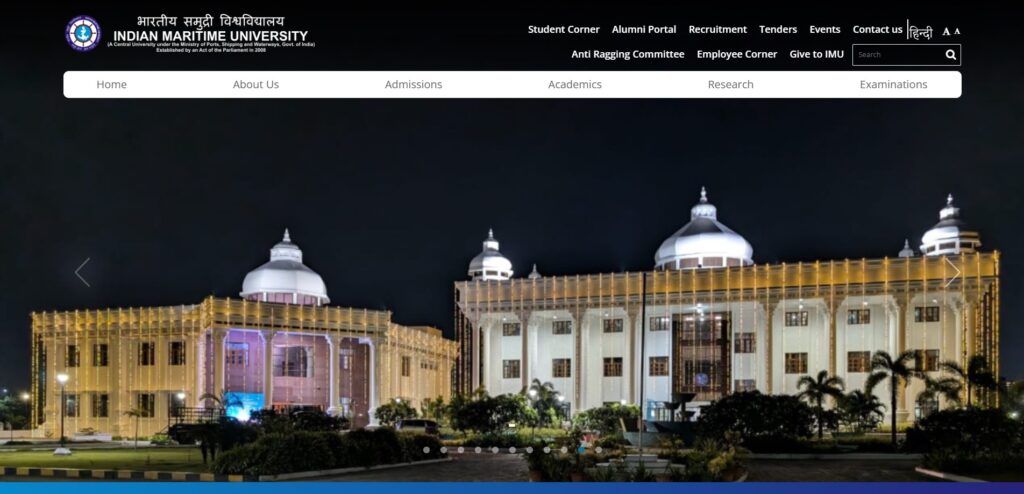
The Indian Maritime University (IMU) stands as the cornerstone of maritime education in India. Established in 2008 by an Act of Parliament, IMU is a Central University dedicated exclusively to the maritime sector. Its creation marked a turning point by bringing maritime education under one unified, high-quality framework.
The vision of IMU is simple yet powerful—to produce competent maritime professionals who can serve both national and global maritime industries. The university focuses on teaching, research, and innovation across all key maritime disciplines.
Campuses of Indian Maritime University
IMU operates through multiple campuses strategically located across India, including Chennai, Mumbai, Kolkata, Visakhapatnam, Cochin, and Kandla. Each campus specializes in certain disciplines and is equipped with modern infrastructure, laboratories, simulators, and training ships.
These campuses act like mini maritime cities, offering students real-world exposure alongside classroom learning. Advanced ship simulators, workshops, and port visits ensure that learning never feels disconnected from reality.
Courses Offered by Indian Maritime University
IMU offers a wide range of undergraduate, postgraduate, and doctoral programs designed to meet industry demands.
Marine Engineering focuses on the operation, maintenance, and management of ship machinery. Students learn everything from engines to automation systems.
Nautical Science prepares students for navigation, ship handling, and maritime safety, paving the way to become deck officers and captains.
Naval Architecture and Ocean Engineering deals with the design, construction, and maintenance of ships and offshore structures. It blends creativity with hardcore engineering.
Shipbuilding and Repair programs cater to the growing demand for shipyards and maintenance facilities in India.
Logistics and Port Management courses focus on supply chain management, port operations, and maritime business, offering excellent shore-based career options.
Admission Process and Eligibility Criteria
Admission to IMU programs is primarily conducted through the IMU Common Entrance Test (IMU-CET). This national-level exam ensures transparency and merit-based selection.
Eligibility varies by course but generally includes a strong foundation in science subjects like Physics, Chemistry, and Mathematics. Medical fitness is also a key requirement for sea-going courses, ensuring candidates are ready for life at sea.
Skill Development and Practical Training
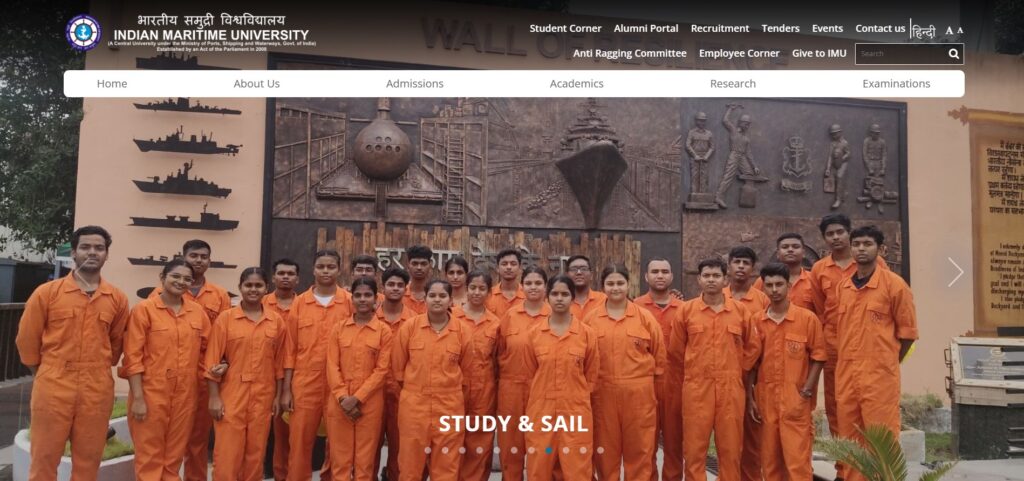
Maritime education is incomplete without hands-on training. IMU places strong emphasis on practical learning through sea-time training, workshops, and industry internships.
Students spend months onboard ships or at ports, learning the ropes—quite literally. This real-world exposure builds confidence, discipline, and problem-solving skills that no textbook can teach.
Job Opportunities in the Maritime Sector
The maritime sector offers two broad career paths: shipboard and shore-based.
Shipboard careers include roles such as deck officers, marine engineers, electro-technical officers, and captains. These jobs offer adventure, global exposure, and high salaries.
Shore-based careers include port management, shipping operations, logistics planning, maritime law, surveying, and consultancy roles. These positions are ideal for those who prefer stability without losing industry relevance.
Career Options After IMU Education
Graduates from IMU are highly sought after by shipping companies, port authorities, shipyards, logistics firms, and offshore companies.
The Merchant Navy remains one of the most popular choices, offering fast career progression and international opportunities.
Ports and Shipping Companies hire IMU graduates for operations, planning, safety, and administrative roles.
The offshore and oil & gas sector offers technically challenging and well-paying jobs, especially for marine engineers and naval architects.
Salary Structure and Career Growth
Maritime careers are known for their impressive salary packages. Entry-level officers can earn anywhere between ₹40,000 to ₹1,50,000 per month, depending on the role and company.
With experience, professionals can earn several lakhs per month, especially in international shipping and offshore sectors. Career growth is structured and performance-based, making the field both rewarding and motivating.
Global Opportunities for Indian Maritime Professionals
One of the biggest advantages of maritime education from IMU is its global recognition. IMU programs comply with international standards, allowing graduates to work with foreign shipping companies and multinational firms.
Indian seafarers are respected worldwide for their skills, discipline, and adaptability. This global demand opens doors far beyond national boundaries.
Challenges and Opportunities in the Maritime Sector
Like any dynamic industry, the maritime sector faces challenges such as automation, environmental regulations, and geopolitical uncertainties. However, these challenges also create opportunities for innovation, research, and specialization.
Green shipping, renewable energy integration, and smart ports are emerging areas where future professionals will play a key role.
Click here to go to the official website
Click here to download the full notification in PDF
Why Choose Maritime Education as a Career
A maritime career is not just a job—it’s a lifestyle. It offers adventure, financial stability, global exposure, and professional prestige. For those who enjoy challenges and responsibility, this field can be incredibly fulfilling.
Think of it as steering your own ship in the vast ocean of opportunities.
Future of Maritime Education in India
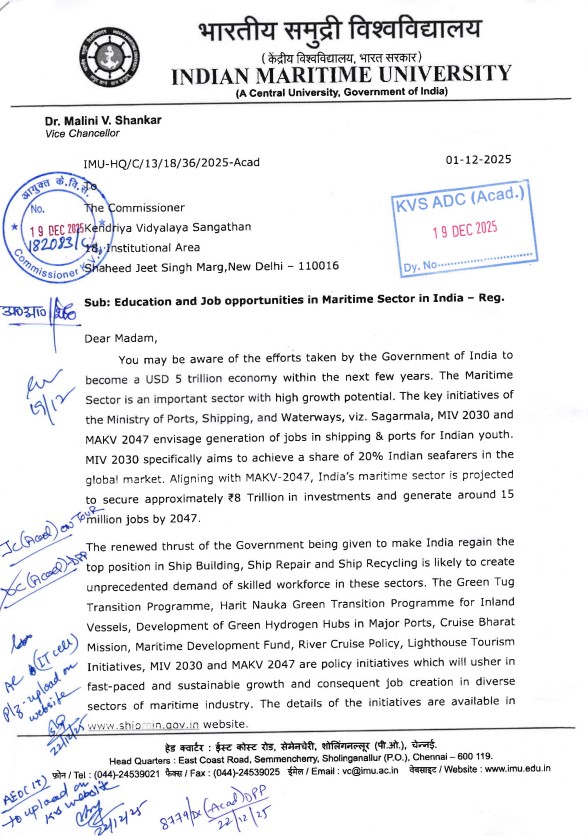
With government initiatives like Sagarmala and increasing investment in port infrastructure, the demand for skilled maritime professionals is set to rise. IMU will continue to play a central role in shaping this future by aligning education with industry needs.
Conclusion
The maritime sector in India is a powerful blend of tradition and technology, offering immense opportunities for education and employment. The Indian Maritime University, as a Central University established by an Act of Parliament, stands at the heart of this ecosystem. By offering specialized courses in marine engineering, nautical studies, naval architecture, ocean engineering, shipbuilding, logistics, and port management, IMU equips students with skills that are globally relevant and future-ready. For students seeking a career that is dynamic, respected, and rewarding, maritime education is truly a voyage worth taking.
Frequently Asked Questions (FAQs)
1. What is the role of Indian Maritime University in India?
IMU provides specialized education and training for careers in the maritime sector and ensures global-standard maritime professionals.
2. Are IMU degrees recognized internationally?
Yes, IMU programs comply with international maritime standards, making them globally recognized.
3. What are the career options after studying at IMU?
Graduates can work in the Merchant Navy, ports, shipping companies, offshore sectors, logistics firms, and shipyards.
4. Is maritime education suitable for girls?
Absolutely. Maritime careers are open to all, and many women are successfully working in both shipboard and shore-based roles.
5. What is the future scope of the maritime sector in India?
With expanding trade, port development, and global demand, the maritime sector has strong long-term growth prospects.
Please don’t forget to leave a review.
Education and Job Opportunities in the Maritime Sector in India
Introduction to the Indian Maritime Sector
India is a nation surrounded by opportunity—quite literally. With a coastline stretching over 7,500 kilometers and access to major international sea routes, the maritime sector has always been the backbone of India’s trade and economic growth. Nearly 90% of India’s trade by volume is carried out through maritime transport, making this sector not just important, but indispensable.
The maritime industry is like a giant engine quietly powering the economy. From cargo ships and ports to logistics hubs and offshore platforms, it offers a wide canvas of education and employment opportunities. As global trade expands, India’s maritime potential continues to grow stronger.
Overview of Maritime Education in India
Maritime education in India has evolved significantly over the past few decades. Earlier, training was limited and scattered. Today, it is structured, standardized, and globally aligned. The Government of India has taken several initiatives to ensure that Indian maritime professionals meet international standards set by bodies like the International Maritime Organization (IMO).
With increasing automation, environmental regulations, and global competition, maritime education now focuses not only on technical knowledge but also on leadership, safety, sustainability, and digital skills.
Indian Maritime University (IMU): An Introduction
The Indian Maritime University (IMU) stands as the cornerstone of maritime education in India. Established in 2008 by an Act of Parliament, IMU is a Central University dedicated exclusively to the maritime sector. Its creation marked a turning point by bringing maritime education under one unified, high-quality framework.
The vision of IMU is simple yet powerful—to produce competent maritime professionals who can serve both national and global maritime industries. The university focuses on teaching, research, and innovation across all key maritime disciplines.
Campuses of Indian Maritime University
IMU operates through multiple campuses strategically located across India, including Chennai, Mumbai, Kolkata, Visakhapatnam, Cochin, and Kandla. Each campus specializes in certain disciplines and is equipped with modern infrastructure, laboratories, simulators, and training ships.
These campuses act like mini maritime cities, offering students real-world exposure alongside classroom learning. Advanced ship simulators, workshops, and port visits ensure that learning never feels disconnected from reality.
Courses Offered by Indian Maritime University
IMU offers a wide range of undergraduate, postgraduate, and doctoral programs designed to meet industry demands.
Marine Engineering focuses on the operation, maintenance, and management of ship machinery. Students learn everything from engines to automation systems.
Nautical Science prepares students for navigation, ship handling, and maritime safety, paving the way to become deck officers and captains.
Naval Architecture and Ocean Engineering deals with the design, construction, and maintenance of ships and offshore structures. It blends creativity with hardcore engineering.
Shipbuilding and Repair programs cater to the growing demand for shipyards and maintenance facilities in India.
Logistics and Port Management courses focus on supply chain management, port operations, and maritime business, offering excellent shore-based career options.
Admission Process and Eligibility Criteria
Admission to IMU programs is primarily conducted through the IMU Common Entrance Test (IMU-CET). This national-level exam ensures transparency and merit-based selection.
Eligibility varies by course but generally includes a strong foundation in science subjects like Physics, Chemistry, and Mathematics. Medical fitness is also a key requirement for sea-going courses, ensuring candidates are ready for life at sea.
Skill Development and Practical Training
Maritime education is incomplete without hands-on training. IMU places strong emphasis on practical learning through sea-time training, workshops, and industry internships.
Students spend months onboard ships or at ports, learning the ropes—quite literally. This real-world exposure builds confidence, discipline, and problem-solving skills that no textbook can teach.
Job Opportunities in the Maritime Sector
The maritime sector offers two broad career paths: shipboard and shore-based.
Shipboard careers include roles such as deck officers, marine engineers, electro-technical officers, and captains. These jobs offer adventure, global exposure, and high salaries.
Shore-based careers include port management, shipping operations, logistics planning, maritime law, surveying, and consultancy roles. These positions are ideal for those who prefer stability without losing industry relevance.
Career Options After IMU Education
Graduates from IMU are highly sought after by shipping companies, port authorities, shipyards, logistics firms, and offshore companies.
The Merchant Navy remains one of the most popular choices, offering fast career progression and international opportunities.
Ports and Shipping Companies hire IMU graduates for operations, planning, safety, and administrative roles.
The offshore and oil & gas sector offers technically challenging and well-paying jobs, especially for marine engineers and naval architects.
Salary Structure and Career Growth
Maritime careers are known for their impressive salary packages. Entry-level officers can earn anywhere between ₹40,000 to ₹1,50,000 per month, depending on the role and company.
With experience, professionals can earn several lakhs per month, especially in international shipping and offshore sectors. Career growth is structured and performance-based, making the field both rewarding and motivating.
Global Opportunities for Indian Maritime Professionals
One of the biggest advantages of maritime education from IMU is its global recognition. IMU programs comply with international standards, allowing graduates to work with foreign shipping companies and multinational firms.
Indian seafarers are respected worldwide for their skills, discipline, and adaptability. This global demand opens doors far beyond national boundaries.
Challenges and Opportunities in the Maritime Sector
Like any dynamic industry, the maritime sector faces challenges such as automation, environmental regulations, and geopolitical uncertainties. However, these challenges also create opportunities for innovation, research, and specialization.
Green shipping, renewable energy integration, and smart ports are emerging areas where future professionals will play a key role.
Click here to go to the official website
Click here to download the full notification in PDF
Why Choose Maritime Education as a Career
A maritime career is not just a job—it’s a lifestyle. It offers adventure, financial stability, global exposure, and professional prestige. For those who enjoy challenges and responsibility, this field can be incredibly fulfilling.
Think of it as steering your own ship in the vast ocean of opportunities.
Future of Maritime Education in India
With government initiatives like Sagarmala and increasing investment in port infrastructure, the demand for skilled maritime professionals is set to rise. IMU will continue to play a central role in shaping this future by aligning education with industry needs.
Conclusion
The maritime sector in India is a powerful blend of tradition and technology, offering immense opportunities for education and employment. The Indian Maritime University, as a Central University established by an Act of Parliament, stands at the heart of this ecosystem. By offering specialized courses in marine engineering, nautical studies, naval architecture, ocean engineering, shipbuilding, logistics, and port management, IMU equips students with skills that are globally relevant and future-ready. For students seeking a career that is dynamic, respected, and rewarding, maritime education is truly a voyage worth taking.
Frequently Asked Questions (FAQs)
1. What is the role of Indian Maritime University in India?
IMU provides specialized education and training for careers in the maritime sector and ensures global-standard maritime professionals.
2. Are IMU degrees recognized internationally?
Yes, IMU programs comply with international maritime standards, making them globally recognized.
3. What are the career options after studying at IMU?
Graduates can work in the Merchant Navy, ports, shipping companies, offshore sectors, logistics firms, and shipyards.
4. Is maritime education suitable for girls?
Absolutely. Maritime careers are open to all, and many women are successfully working in both shipboard and shore-based roles.
5. What is the future scope of the maritime sector in India?
With expanding trade, port development, and global demand, the maritime sector has strong long-term growth prospects.
Please don’t forget to leave a review.
Education and Job Opportuniti9es in the Maritime Sector in India
Introduction to the Indian Maritime Sector
India is a nation surrounded by opportunity—quite literally. With a coastline stretching over 7,500 kilometers and access to major international sea routes, the maritime sector has always been the backbone of India’s trade and economic growth. Nearly 90% of India’s trade by volume is carried out through maritime transport, making this sector not just important, but indispensable.
The maritime industry is like a giant engine quietly powering the economy. From cargo ships and ports to logistics hubs and offshore platforms, it offers a wide canvas of education and employment opportunities. As global trade expands, India’s maritime potential continues to grow stronger.
Overview of Maritime Education in India
Maritime education in India has evolved significantly over the past few decades. Earlier, training was limited and scattered. Today, it is structured, standardized, and globally aligned. The Government of India has taken several initiatives to ensure that Indian maritime professionals meet international standards set by bodies like the International Maritime Organization (IMO).
With increasing automation, environmental regulations, and global competition, maritime education now focuses not only on technical knowledge but also on leadership, safety, sustainability, and digital skills.
Indian Maritime University (IMU): An Introduction
The Indian Maritime University (IMU) stands as the cornerstone of maritime education in India. Established in 2008 by an Act of Parliament, IMU is a Central University dedicated exclusively to the maritime sector. Its creation marked a turning point by bringing maritime education under one unified, high-quality framework.
The vision of IMU is simple yet powerful—to produce competent maritime professionals who can serve both national and global maritime industries. The university focuses on teaching, research, and innovation across all key maritime disciplines.
Campuses of Indian Maritime University
IMU operates through multiple campuses strategically located across India, including Chennai, Mumbai, Kolkata, Visakhapatnam, Cochin, and Kandla. Each campus specializes in certain disciplines and is equipped with modern infrastructure, laboratories, simulators, and training ships.
These campuses act like mini maritime cities, offering students real-world exposure alongside classroom learning. Advanced ship simulators, workshops, and port visits ensure that learning never feels disconnected from reality.
Courses Offered by Indian Maritime University
IMU offers a wide range of undergraduate, postgraduate, and doctoral programs designed to meet industry demands.
Marine Engineering focuses on the operation, maintenance, and management of ship machinery. Students learn everything from engines to automation systems.
Nautical Science prepares students for navigation, ship handling, and maritime safety, paving the way to become deck officers and captains.
Naval Architecture and Ocean Engineering deals with the design, construction, and maintenance of ships and offshore structures. It blends creativity with hardcore engineering.
Shipbuilding and Repair programs cater to the growing demand for shipyards and maintenance facilities in India.
Logistics and Port Management courses focus on supply chain management, port operations, and maritime business, offering excellent shore-based career options.
Admission Process and Eligibility Criteria
Admission to IMU programs is primarily conducted through the IMU Common Entrance Test (IMU-CET). This national-level exam ensures transparency and merit-based selection.
Eligibility varies by course but generally includes a strong foundation in science subjects like Physics, Chemistry, and Mathematics. Medical fitness is also a key requirement for sea-going courses, ensuring candidates are ready for life at sea.
Skill Development and Practical Training
Maritime education is incomplete without hands-on training. IMU places strong emphasis on practical learning through sea-time training, workshops, and industry internships.
Students spend months onboard ships or at ports, learning the ropes—quite literally. This real-world exposure builds confidence, discipline, and problem-solving skills that no textbook can teach.
Job Opportunities in the Maritime Sector
The maritime sector offers two broad career paths: shipboard and shore-based.
Shipboard careers include roles such as deck officers, marine engineers, electro-technical officers, and captains. These jobs offer adventure, global exposure, and high salaries.
Shore-based careers include port management, shipping operations, logistics planning, maritime law, surveying, and consultancy roles. These positions are ideal for those who prefer stability without losing industry relevance.
Career Options After IMU Education
Graduates from IMU are highly sought after by shipping companies, port authorities, shipyards, logistics firms, and offshore companies.
The Merchant Navy remains one of the most popular choices, offering fast career progression and international opportunities.
Ports and Shipping Companies hire IMU graduates for operations, planning, safety, and administrative roles.
The offshore and oil & gas sector offers technically challenging and well-paying jobs, especially for marine engineers and naval architects.
Salary Structure and Career Growth
Maritime careers are known for their impressive salary packages. Entry-level officers can earn anywhere between ₹40,000 to ₹1,50,000 per month, depending on the role and company.
With experience, professionals can earn several lakhs per month, especially in international shipping and offshore sectors. Career growth is structured and performance-based, making the field both rewarding and motivating.
Global Opportunities for Indian Maritime Professionals
One of the biggest advantages of maritime education from IMU is its global recognition. IMU programs comply with international standards, allowing graduates to work with foreign shipping companies and multinational firms.
Indian seafarers are respected worldwide for their skills, discipline, and adaptability. This global demand opens doors far beyond national boundaries.
Challenges and Opportunities in the Maritime Sector
Like any dynamic industry, the maritime sector faces challenges such as automation, environmental regulations, and geopolitical uncertainties. However, these challenges also create opportunities for innovation, research, and specialization.
Green shipping, renewable energy integration, and smart ports are emerging areas where future professionals will play a key role.
Click here to go to the official website
Click here to download the full notification in PDF
Why Choose Maritime Education as a Career
A maritime career is not just a job—it’s a lifestyle. It offers adventure, financial stability, global exposure, and professional prestige. For those who enjoy challenges and responsibility, this field can be incredibly fulfilling.
Think of it as steering your own ship in the vast ocean of opportunities.
Future of Maritime Education in India
With government initiatives like Sagarmala and increasing investment in port infrastructure, the demand for skilled maritime professionals is set to rise. IMU will continue to play a central role in shaping this future by aligning education with industry needs.
Conclusion
The maritime sector in India is a powerful blend of tradition and technology, offering immense opportunities for education and employment. The Indian Maritime University, as a Central University established by an Act of Parliament, stands at the heart of this ecosystem. By offering specialized courses in marine engineering, nautical studies, naval architecture, ocean engineering, shipbuilding, logistics, and port management, IMU equips students with skills that are globally relevant and future-ready. For students seeking a career that is dynamic, respected, and rewarding, maritime education is truly a voyage worth taking.
Frequently Asked Questions (FAQs)
1. What is the role of Indian Maritime University in India?
IMU provides specialized education and training for careers in the maritime sector and ensures global-standard maritime professionals.
2. Are IMU degrees recognized internationally?
Yes, IMU programs comply with international maritime standards, making them globally recognized.
3. What are the career options after studying at IMU?
Graduates can work in the Merchant Navy, ports, shipping companies, offshore sectors, logistics firms, and shipyards.
4. Is maritime education suitable for girls?
Absolutely. Maritime careers are open to all, and many women are successfully working in both shipboard and shore-based roles.
5. What is the future scope of the maritime sector in India?
With expanding trade, port development, and global demand, the maritime sector has strong long-term growth prospects.
Please don’t forget to leave a review.
Education and Job Opportunities in the Maritime Sector in India
Introduction to the Indian Maritime Sector
India is a nation surrounded by opportunity—quite literally. With a coastline stretching over 7,500 kilometers and access to major international sea routes, the maritime sector has always been the backbone of India’s trade and economic growth. Nearly 90% of India’s trade by volume is carried out through maritime transport, making this sector not just important, but indispensable.
The maritime industry is like a giant engine quietly powering the economy. From cargo ships and ports to logistics hubs and offshore platforms, it offers a wide canvas of education and employment opportunities. As global trade expands, India’s maritime potential continues to grow stronger.
Overview of Maritime Education in India
Maritime education in India has evolved significantly over the past few decades. Earlier, training was limited and scattered. Today, it is structured, standardized, and globally aligned. The Government of India has taken several initiatives to ensure that Indian maritime professionals meet international standards set by bodies like the International Maritime Organization (IMO).
With increasing automation, environmental regulations, and global competition, maritime education now focuses not only on technical knowledge but also on leadership, safety, sustainability, and digital skills.
Indian Maritime University (IMU): An Introduction
The Indian Maritime University (IMU) stands as the cornerstone of maritime education in India. Established in 2008 by an Act of Parliament, IMU is a Central University dedicated exclusively to the maritime sector. Its creation marked a turning point by bringing maritime education under one unified, high-quality framework.
The vision of IMU is simple yet powerful—to produce competent maritime professionals who can serve both national and global maritime industries. The university focuses on teaching, research, and innovation across all key maritime disciplines.
Campuses of Indian Maritime University
IMU operates through multiple campuses strategically located across India, including Chennai, Mumbai, Kolkata, Visakhapatnam, Cochin, and Kandla. Each campus specializes in certain disciplines and is equipped with modern infrastructure, laboratories, simulators, and training ships.
These campuses act like mini maritime cities, offering students real-world exposure alongside classroom learning. Advanced ship simulators, workshops, and port visits ensure that learning never feels disconnected from reality.
Courses Offered by Indian Maritime University
IMU offers a wide range of undergraduate, postgraduate, and doctoral programs designed to meet industry demands.
Marine Engineering focuses on the operation, maintenance, and management of ship machinery. Students learn everything from engines to automation systems.
Nautical Science prepares students for navigation, ship handling, and maritime safety, paving the way to become deck officers and captains.
Naval Architecture and Ocean Engineering deals with the design, construction, and maintenance of ships and offshore structures. It blends creativity with hardcore engineering.
Shipbuilding and Repair programs cater to the growing demand for shipyards and maintenance facilities in India.
Logistics and Port Management courses focus on supply chain management, port operations, and maritime business, offering excellent shore-based career options.
Admission Process and Eligibility Criteria
Admission to IMU programs is primarily conducted through the IMU Common Entrance Test (IMU-CET). This national-level exam ensures transparency and merit-based selection.
Eligibility varies by course but generally includes a strong foundation in science subjects like Physics, Chemistry, and Mathematics. Medical fitness is also a key requirement for sea-going courses, ensuring candidates are ready for life at sea.
Skill Development and Practical Training
Maritime education is incomplete without hands-on training. IMU places strong emphasis on practical learning through sea-time training, workshops, and industry internships.
Students spend months onboard ships or at ports, learning the ropes—quite literally. This real-world exposure builds confidence, discipline, and problem-solving skills that no textbook can teach.
Job Opportunities in the Maritime Sector
The maritime sector offers two broad career paths: shipboard and shore-based.
Shipboard careers include roles such as deck officers, marine engineers, electro-technical officers, and captains. These jobs offer adventure, global exposure, and high salaries.
Shore-based careers include port management, shipping operations, logistics planning, maritime law, surveying, and consultancy roles. These positions are ideal for those who prefer stability without losing industry relevance.
Career Options After IMU Education
Graduates from IMU are highly sought after by shipping companies, port authorities, shipyards, logistics firms, and offshore companies.
The Merchant Navy remains one of the most popular choices, offering fast career progression and international opportunities.
Ports and Shipping Companies hire IMU graduates for operations, planning, safety, and administrative roles.
The offshore and oil & gas sector offers technically challenging and well-paying jobs, especially for marine engineers and naval architects.
Salary Structure and Career Growth
Maritime careers are known for their impressive salary packages. Entry-level officers can earn anywhere between ₹40,000 to ₹1,50,000 per month, depending on the role and company.
With experience, professionals can earn several lakhs per month, especially in international shipping and offshore sectors. Career growth is structured and performance-based, making the field both rewarding and motivating.
Global Opportunities for Indian Maritime Professionals
One of the biggest advantages of maritime education from IMU is its global recognition. IMU programs comply with international standards, allowing graduates to work with foreign shipping companies and multinational firms.
Indian seafarers are respected worldwide for their skills, discipline, and adaptability. This global demand opens doors far beyond national boundaries.
Challenges and Opportunities in the Maritime Sector
Like any dynamic industry, the maritime sector faces challenges such as automation, environmental regulations, and geopolitical uncertainties. However, these challenges also create opportunities for innovation, research, and specialization.
Green shipping, renewable energy integration, and smart ports are emerging areas where future professionals will play a key role.
Click here to go to the official website
Click here to download the full notification in PDF
Why Choose Maritime Education as a Career
A maritime career is not just a job—it’s a lifestyle. It offers adventure, financial stability, global exposure, and professional prestige. For those who enjoy challenges and responsibility, this field can be incredibly fulfilling.
Think of it as steering your own ship in the vast ocean of opportunities.
Future of Maritime Education in India
With government initiatives like Sagarmala and increasing investment in port infrastructure, the demand for skilled maritime professionals is set to rise. IMU will continue to play a central role in shaping this future by aligning education with industry needs.
Conclusion
The maritime sector in India is a powerful blend of tradition and technology, offering immense opportunities for education and employment. The Indian Maritime University, as a Central University established by an Act of Parliament, stands at the heart of this ecosystem. By offering specialized courses in marine engineering, nautical studies, naval architecture, ocean engineering, shipbuilding, logistics, and port management, IMU equips students with skills that are globally relevant and future-ready. For students seeking a career that is dynamic, respected, and rewarding, maritime education is truly a voyage worth taking.
Frequently Asked Questions (FAQs)
1. What is the role of Indian Maritime University in India?
IMU provides specialized education and training for careers in the maritime sector and ensures global-standard maritime professionals.
2. Are IMU degrees recognized internationally?
Yes, IMU programs comply with international maritime standards, making them globally recognized.
3. What are the career options after studying at IMU?
Graduates can work in the Merchant Navy, ports, shipping companies, offshore sectors, logistics firms, and shipyards.
4. Is maritime education suitable for girls?
Absolutely. Maritime careers are open to all, and many women are successfully working in both shipboard and shore-based roles.
5. What is the future scope of the maritime sector in India?
With expanding trade, port development, and global demand, the maritime sector has strong long-term growth prospects.
Please don’t forget to leave a review.
Disclaimer
The information provided is for general informational purposes only. While every effort has been made to ensure accuracy, details related to education programs and job opportunities in the maritime sector may change over time. Users are advised to verify information with official institutions or authorities.